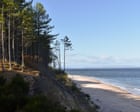
Thousands of rare wildflowers rescued from eroding Scottish coast

Thousands of rare wildflowers rescued from eroding Scottish coast

Conservationists relocate 3,400 one-flowered wintergreens, a species estimated to have lost more than half its UK population in the past 50 years

Thousands of one of Britain’s rarest wildflowers have been moved to safety from an eroding Scottish shoreline where they were at risk of falling into the sea.

Conservationists rescued 3,400 one-flowered wintergreen plants at Culbin Forest in Moray, in an effort to protect a species estimated to have lost more than half its UK population in the past 50 years.

“We don’t yet know how many plants will survive at their new home in Culbin Forest, but we do know that it was only a matter of time before they would have all been lost to the sea if we’d left them where they were,” said Iain Macdonald, a biodiversity adviser at NatureScot.

In the UK, the tiny, star-shaped wildflower is found only in pine woods in north-east Scotland. It survives at just seven sites, only three of which support healthy populations, according to Plantlife Scotland.

The charity worked with Forestry and Land Scotland, NatureScot and volunteers to relocate the plants after 2-3 metres of land collapsed into the sea over recent years.

Sam Jones, senior ecological adviser at Plantlife Scotland, said: “This type of groundbreaking conservation work will help ensure endangered species like the one-flowered wintergreen are…

In brief

Conservationists relocate 3,400 one-flowered wintergreens, a species estimated to have lost more than half its UK population in the past 50 years Thousands of one of Britain’s rarest wildflowers have been moved to safety from an eroding Scottish shoreline where they were at risk of falling into the sea. It survives at just seven sites, only three of which support healthy populations, according to Plantlife Scotland.

This is the opening of the story, shared with credit to The Guardian — World. The rest of the report — with every detail — continues on the publisher’s website.

Continue reading at The Guardian — World ↗

Cookie settings

Choose which cookies we may use. You can change this at any time from Cookie settings in the footer. Details of each cookie are in the Cookie Policy.

Strictly necessary

Needed for sign-in, security, payments and remembering these choices. Always on.

Preferences

Remember settings such as dark mode.

Analytics & performance

Help us count visits, understand which pages, devices and countries our readers use, and measure how well the site performs – anonymous and aggregated.

Advertising & marketing

Lets advertising partners show and personalise adverts, measure impressions, clicks and visits, prevent ad fraud and pay us – this is how the free site is funded.

🔔 News notifications

Get headlines from NewsHub on this device — even when the site is closed.

You can switch this off at any time. Works on Android, Windows, Mac and Linux browsers; on iPhone/iPad add the site to your Home Screen first.