

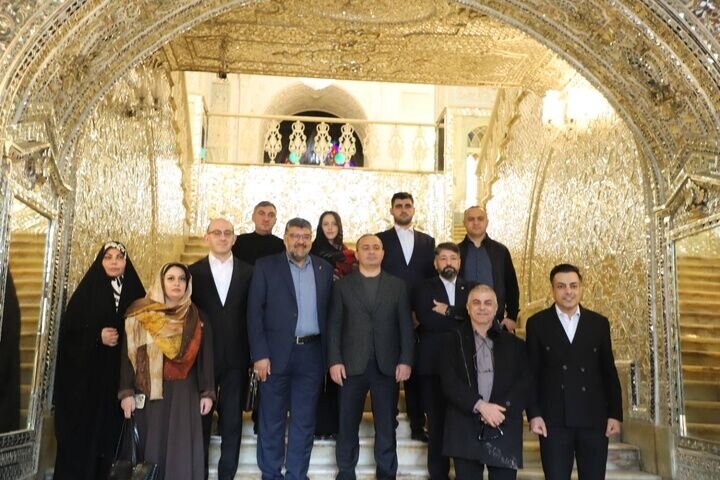
TEHRAN – An Armenian delegation, accompanied by Iranian judiciary officials, visited damaged sections of the UNESCO-listed Golestan Palace in central Tehran on Saturday to inspect the impact of US and Israeli airstrikes on the historic complex.
Alireza Razeghi, director of the Golestan Palace World Heritage complex, accompanied the visitors on Saturday and outlined the damage sustained by different sections of the historic site. He also briefed them on the palace’s history, cultural significance and international heritage value, IRNA reported.
Razeghi emphasized that Golestan Palace, which is inscribed on UNESCO’s World Heritage List, is not merely part of Iran’s national history and cultural identity but also an important component of the shared heritage of humanity.
The palace sustained considerable damage following US and Israeli airstrikes on March 1, which struck targets near the historic complex in downtown Tehran. The resulting shockwaves damaged several historic buildings, architectural features and museum objects.
Among the affected structures was the Takht-e Marmar (Marble Throne) Hall, where parts of the architectural framework sustained significant damage, although the building’s overall structure remained largely intact.
The Hall of Mirrors, which houses a painting by renowned Iranian artist Kamal-ol-Molk and had recently undergone renovation, also suffered damage to its ceiling and traditional decorative features.