

We have figured out travel by road, rail, air and even sea, but walking on water on our own two feet? That is one mode of transport that still seems rather far-fetched, almost like a magical feat. But perhaps not so much for nine grasshoppers preserved in amber for nearly 100 million years.According to a research report published by the Nanjing Institute of Geology and Palaeontology, Chinese Academy of Sciences (NIGPAS), on November 24, 2026, researchers have identified a previously unknown group of semi-aquatic grasshoppers preserved in mid-Cretaceous amber from Myanmar. The study, titled Extreme morphological specialization in Mesozoic water-walking grasshoppers, was published in the journal Proceedings of the Royal Society B on November 18, 2026.The discoveryThe fossils were identified by a research team led by postdoctoral researchers Xu Chunpeng and Luo Cihang from NIGPAS, in collaboration with Rolf G. Beutel from Friedrich Schiller University Jena in Germany and Thet Tin Nyunt from the Myanma Gems Museum in Myanmar. The researchers came across these specimens while examining amber fossils dating back approximately 100 million years, finding grasshoppers that did not resemble what one would traditionally imagine them to look like.In fact, their unusual body structure initially made them difficult to identify.
Trapped in amber for about 100 million years, nine ancient grasshoppers revealed
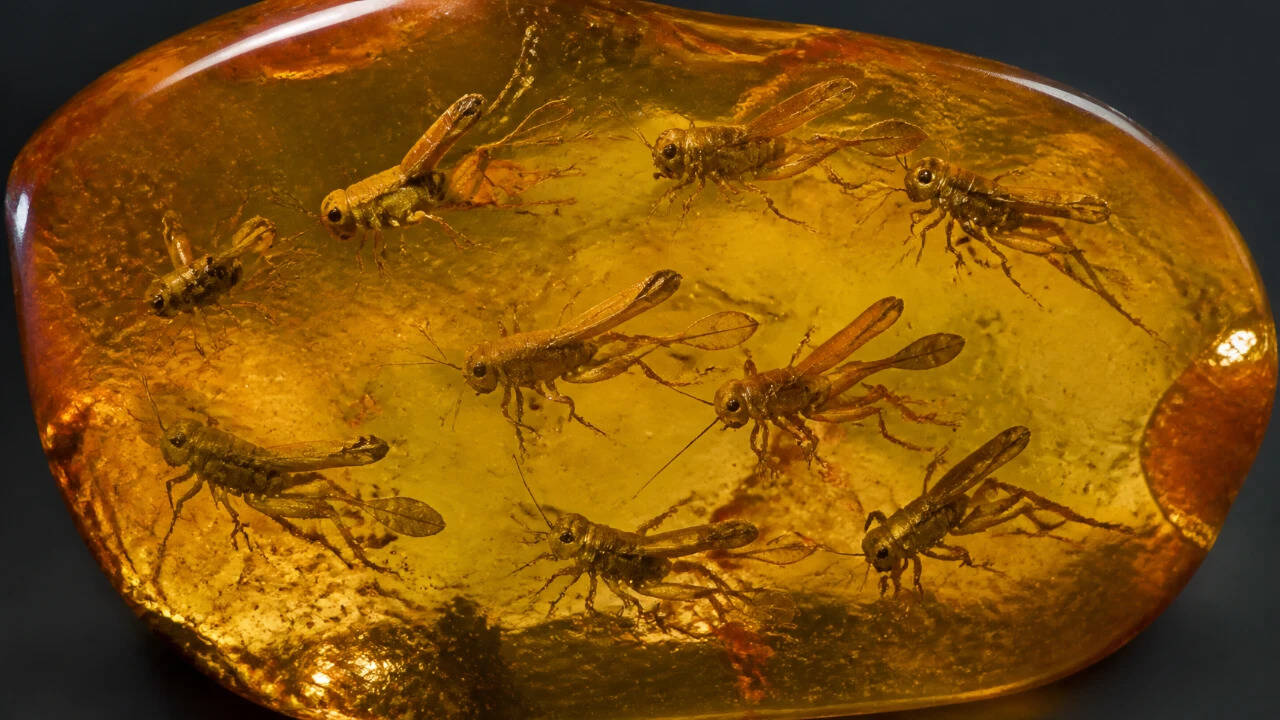
A remarkable discovery was made by researchers who identified a new genus of semi-aquatic grasshoppers called Hydrelcana zhangi, preserved in ancient amber. These intriguing insects exhibited distinct anatomical adaptations that enabled them to walk on water, showcasing an independent evolutionary path separate from modern water striders. Fossil evidence indicates their possible social behavior, as they might have…
In brief
We have figured out travel by road, rail, air and even sea, but walking on water on our own two feet? But perhaps not so much for nine grasshoppers preserved in amber for nearly 100 million years.According to a research report published by the Nanjing Institute of Geology and Palaeontology, Chinese Academy of Sciences (NIGPAS), on November 24, 2026, researchers have identified a previously unknown group of semi-aquatic grasshoppers preserved in mid-Cretaceous amber from Myanmar.
This is the opening of the story, shared with credit to The Times of India — World. The rest of the report — with every detail — continues on the publisher’s website.
Continue reading at The Times of India — World ↗