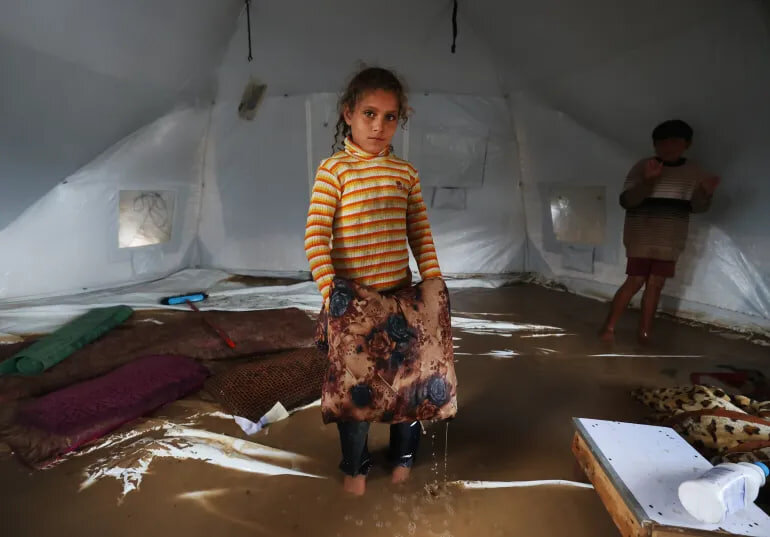
Flooded tents deepen the misery of displaced Gazans

Flooded tents deepen the misery of displaced Gazans

TEHRAN - In Gaza, even the weather has become an enemy that the international community refuses to confront.

When a sand dune collapses onto a tent sheltering displaced Palestinians, killing four children and a woman, it is tempting to describe the tragedy as another consequence of winter storms. But there is nothing natural about a catastrophe in which people have been driven from their homes, denied the means to rebuild them and left to face freezing temperatures under pieces of canvas. The rain may have triggered the collapse, but the conditions that made it deadly were created by a human-made siege.

Behind these tragedies lies a reality that no humanitarian statement can adequately capture: families who survived bombardment are now struggling to survive the cold, flooding and collapsing ground. They escaped Israeli attacks only to find themselves exposed to another form of danger.

For the fourth consecutive winter, Palestinians are being forced to endure conditions that no civilian population should be expected to survive. The first major winter storm reportedly flooded around 70,000 tents within approximately twelve hours.

Humanitarian organizations estimate that Gaza needs between 200,000 and 300,000 new tents or caravans to provide displaced families with even basic protection.

Meanwhile, around one million women and girls are facing hunger and the additional dangers of living in overcrowded, flooded shelters…

In brief

TEHRAN - In Gaza, even the weather has become an enemy that the international community refuses to confront. When a sand dune collapses onto a tent sheltering displaced Palestinians, killing four children and a woman, it is tempting to describe the tragedy as another consequence of winter storms. The first major winter storm reportedly flooded around 70,000 tents within approximately twelve hours. Humanitarian organizations estimate that Gaza needs between 200,000 and 300,000 new tents or caravans to provide displaced families with even basic protection.

This is the opening of the story, shared with credit to Tehran Times. The rest of the report — with every detail — continues on the publisher’s website.

Continue reading at Tehran Times ↗

Cookie settings

Choose which cookies we may use. You can change this at any time from Cookie settings in the footer. Details of each cookie are in the Cookie Policy.

Strictly necessary

Needed for sign-in, security, payments and remembering these choices. Always on.

Preferences

Remember settings such as dark mode.

Analytics & performance

Help us count visits, understand which pages, devices and countries our readers use, and measure how well the site performs – anonymous and aggregated.

Advertising & marketing

Lets advertising partners show and personalise adverts, measure impressions, clicks and visits, prevent ad fraud and pay us – this is how the free site is funded.

🔔 News notifications

Get headlines from NewsHub on this device — even when the site is closed.

You can switch this off at any time. Works on Android, Windows, Mac and Linux browsers; on iPhone/iPad add the site to your Home Screen first.