
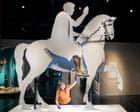
Once thought to have been looted by Scottish tribes, the gilded limb is the centrepiece of a new exhibition on Roman Scotland in Edinburgh
A large bronze leg found in a bog in rural Scotland more than 200 years ago and then hidden away in a duke’s storeroom is helping to rewrite the history of the Roman empire.
Antiquarians argued that the so-called Mislington leg had been looted, perhaps from York, hacked off by marauding Scottish tribes and carried north over Hadrian’s Wall. “We cannot visualise the conditions which would have led to its erection anywhere north of the Great Wall,” said one scholar, James Curle, in 1932.
But archaeologists now believe the hefty gilded bronze limb came from the Scottish Borders and was part of a vast statue of the emperor Antoninus Pius on horseback, erected near Hawick after his armies had wrested control of southern Scotland in about AD140.
Bearing significant similarities to imperial statues in other frontier regions, it is the centrepiece of the largest exhibition ever staged on the Romans in Scotland, which opens on Saturday at the National Museum of Scotland in Edinburgh.
It had languished for 100 years in the “charter room” at Dalkeith House near Edinburgh, one of the stately homes owned by the Duke of Buccleuch, after being dug up in 1820.
