First guidelines on attempts to manipulate the ocean put spotlight on geoengineering industry

First guidelines on attempts to manipulate the ocean put spotlight on geoengineering industry

Proponents argue ocean carbon removal is necessary to counteract the effects of the climate crisis but critics say more research is needed

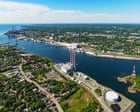
A cluster of candy cane-striped smoke stacks dots the horizon of Tufts Cove in Nova Scotia, Canada. Deep in the briny depths of Halifax harbour, something huge is happening: the ocean is being engineered to remove atmospheric carbon.

“This is what Mother Nature has done naturally for a few billion years in order to rebalance the atmospheric and ocean chemistry over long timescales,” says Dr Greg Rau, co-founder and senior scientist at Planetary Technologies.

Planetary Technologies is an ocean carbon-removal firm and one of a growing number of companies attempting to decrease excess atmospheric carbon – the main driver of the climate crisis – by speeding up naturally occurring carbon cycles in the ocean.

To do this, the company conducts ocean alkalinity enhancement (OAE), adding a chalk-like substance to the seawater, which allows the water to absorb and store more atmospheric carbon than usual.

This process also helps to offset ocean acidification, often called the “evil twin” of the climate crisis, which is increasing dramatically.

Because it relies on an already occurring process, proponents say these technologies will not harm the marine creatures that call this harbour home, such as mackerel, sunfish, harbour seals and sea turtles.

In brief

Proponents argue ocean carbon removal is necessary to counteract the effects of the climate crisis but critics say more research is needed A cluster of candy cane-striped smoke stacks dots the horizon of Tufts Cove in Nova Scotia, Canada. Planetary Technologies is an ocean carbon-removal firm and one of a growing number of companies attempting to decrease excess atmospheric carbon – the main driver of the climate crisis – by speeding up naturally occurring carbon cycles in the ocean.

This is the opening of the story, shared with credit to The Guardian — Americas. The rest of the report — with every detail — continues on the publisher’s website.

Continue reading at The Guardian — Americas ↗

Cookie settings

Choose which cookies we may use. You can change this at any time from Cookie settings in the footer. Details of each cookie are in the Cookie Policy.

Strictly necessary

Needed for sign-in, security, payments and remembering these choices. Always on.

Preferences

Remember settings such as dark mode.

Analytics & performance

Help us count visits, understand which pages, devices and countries our readers use, and measure how well the site performs – anonymous and aggregated.

Advertising & marketing

Lets advertising partners show and personalise adverts, measure impressions, clicks and visits, prevent ad fraud and pay us – this is how the free site is funded.

🔔 News notifications

Get headlines from NewsHub on this device — even when the site is closed.

You can switch this off at any time. Works on Android, Windows, Mac and Linux browsers; on iPhone/iPad add the site to your Home Screen first.