
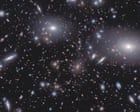
Unprecedented view of cosmos provided by Euclid mission throws up many more cases of gravitational lensing
A mission to create the largest ever 3D map of the universe has revealed more than 900m galaxies in its first major data release together with about 15,000 potential cases of a phenomenon that could help unlock the secrets of the “dark universe”.
Launched in July 2023, the European Space Agency’s Euclid mission promised to create the largest cosmic map ever made, encompassing a third of the sky and more than 10bn years of cosmic history.
The goal is to shed light on two of the biggest mysteries in the universe: the nature of dark energy and dark matter. These are thought to make up about 70% and 25% of the universe respectively.
Prof Andy Taylor, of the University of Edinburgh, who leads the UK science ground segment for the mission, said while there were bigger surveys, none had the detail and the information content of Euclid. By contrast the Hubble telescope has produced images of incredible resolution, but does not cover as large an area of the sky.
“The technological leap that’s Euclid is that we can keep that high resolution, but now we can basically map huge volumes of the sky, huge volumes of the universe,” Taylor said.
