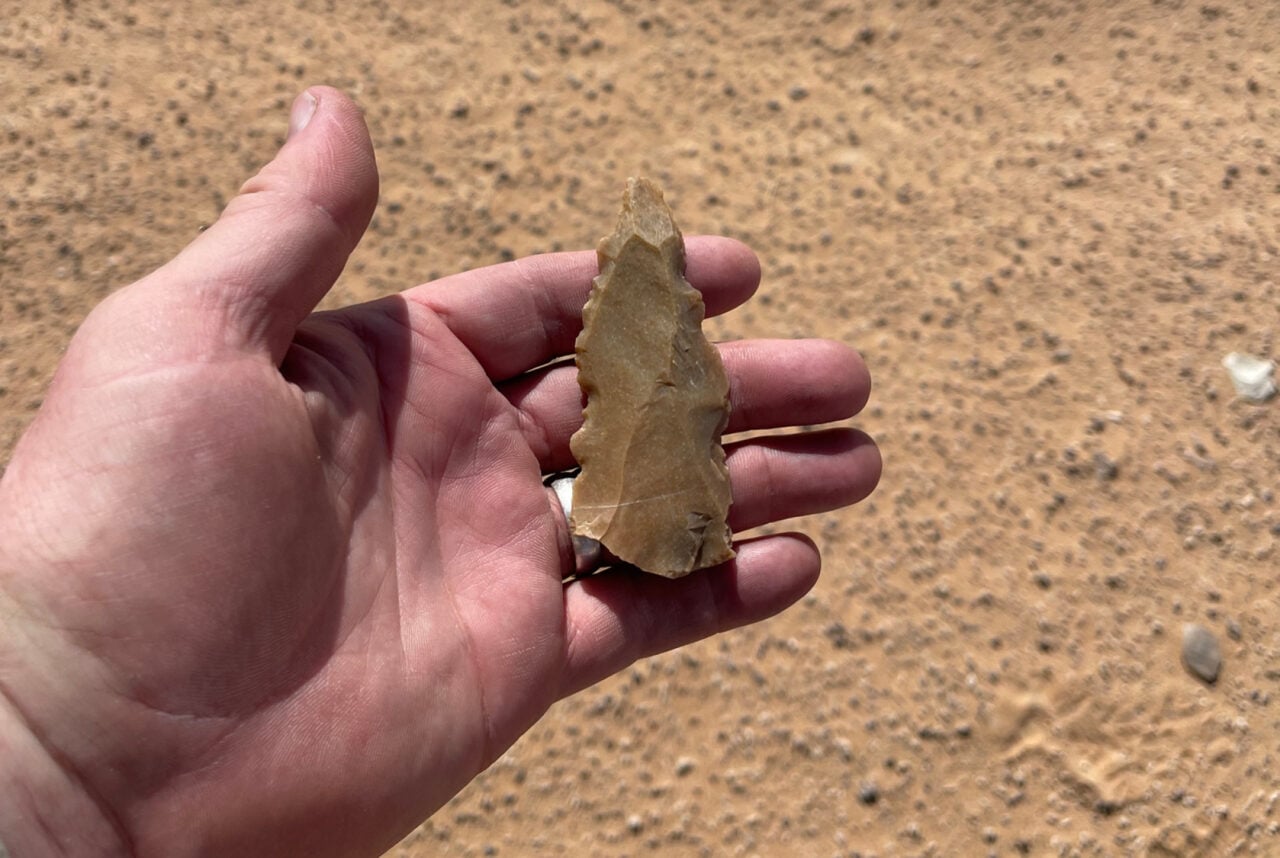
Today, the Arabian Peninsula is mostly a desert. But things were very different hundreds of thousands of years ago. In fact, the landscape supported an ancient community of talented crafters who possibly made poisonous weapons.
An international team of scientists studied traces of human occupation at Uruq Aljelibah, a Middle Paleolithic site around 125,000 years old. Their findings, published today in Science, describe a remarkably well-preserved record of how prehistoric humans and wildlife coexisted around an ancient freshwater lake, located in what is now Saudi Arabia. The excavations turned up roughly 5,000 stone artifacts and fossil remains. One standout discovery was a carefully shaped stone point with chemical traces from poisonous plants—hinting at the community’s crafting skills. The findings challenge the idea that continued, permanent human occupation was rare in Paleolithic Arabia.
These humans were “using sophisticated stone-tipped weapons, possibly incorporating plant poisons, along with adhesives and plant-fiber technologies,” Chris Clarkson, the study’s first author and an archaeologist at Griffith University in Australia, told Gizmodo. “It gives us an unusually detailed picture of early human life in what is now one of the driest regions on Earth.”
During the Pleistocene, the Arabian Peninsula experienced significant climate and environmental changes, according to the paper. That brought humid phases to the region, turning it into what some experts have dubbed “Green Arabia.”…