📰 Newspapers

A Mysterious Radio Signal Repeats Every 8 Minutes. Astronomers Finally Know What’s Behind It

A Mysterious Radio Signal Repeats Every 8 Minutes. Astronomers Finally Know What’s Behind It

It’s the first observation of its kind.

As astronomers survey the universe, they often encounter signals without a clear source. Although they usually find the source, some answers are weirder than others—take, for example, the mysterious pulses from a star that’s already dead.

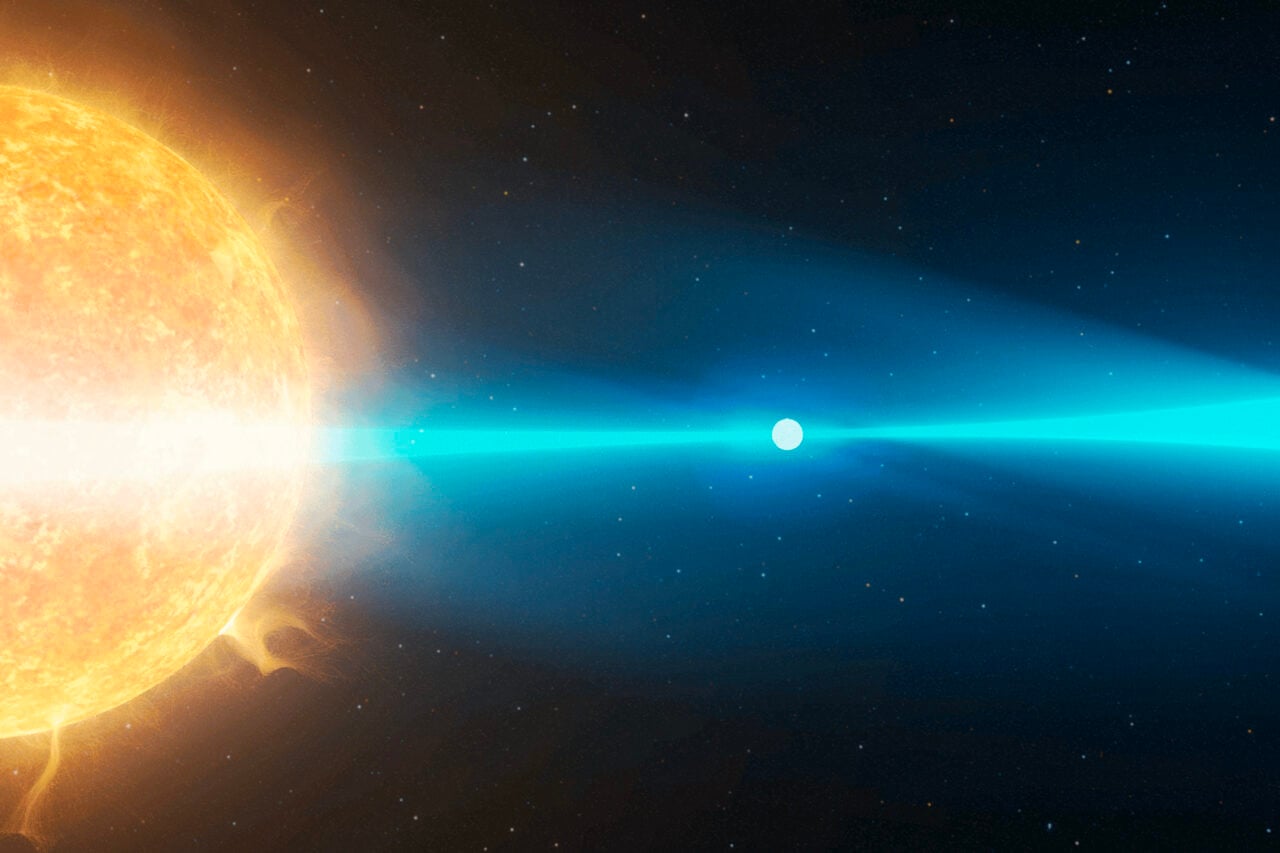
Beginning in late 2024, the Murchison Widefield Array (MWA) in Australia detected GPM J071507−114153, a radio signal that pulsated roughly every eight minutes. From December 2024 to September 2025, the MWA detected 214 pulses from the source, and astronomers classified the signal as a long-period transient. In a study published today in Nature Astronomy, researchers reported the most likely source for this signal: a binary star system consisting of one white dwarf—the leftover core from a star’s death—and a G-type star like our Sun. The astronomers say it’s the first detection of radio pulses emanating from a white dwarf orbiting a Sun-like star rather than a red dwarf.

“It’s amazing that by using radio wavelengths we can detect the storms on a star over 5,000 light-years away,” Natasha Hurley-Walker, a corresponding author of the study and an astronomer at Curtin University in Australia, said in a statement.

Long-period transients are a relatively new category of space signals. Scientists first got wind of this type of radiation in 2005, but it was in 2022 that the community really started to study long-period transients.

In brief

As astronomers survey the universe, they often encounter signals without a clear source. Beginning in late 2024, the Murchison Widefield Array (MWA) in Australia detected GPM J071507−114153, a radio signal that pulsated roughly every eight minutes. The astronomers say it’s the first detection of radio pulses emanating from a white dwarf orbiting a Sun-like star rather than a red dwarf.

This is the opening of the story, shared with credit to Gizmodo. The rest of the report — with every detail — continues on the publisher’s website.

Continue reading at Gizmodo ↗

Cookie settings

Choose which cookies we may use. You can change this at any time from Cookie settings in the footer. Details of each cookie are in the Cookie Policy.

Strictly necessary

Needed for sign-in, security, payments and remembering these choices. Always on.

Preferences

Remember settings such as dark mode.

Analytics & performance

Help us count visits, understand which pages, devices and countries our readers use, and measure how well the site performs – anonymous and aggregated.

Advertising & marketing

Lets advertising partners show and personalise adverts, measure impressions, clicks and visits, prevent ad fraud and pay us – this is how the free site is funded.

🔔 News notifications

Get headlines from NewsHub on this device — even when the site is closed.

You can switch this off at any time. Works on Android, Windows, Mac and Linux browsers; on iPhone/iPad add the site to your Home Screen first.