
There is a rather innocent idea we, as children, have grown up listening to when it comes to death. When our loved ones pass away, we are often told to look up at the stars and imagine them resting somewhere in the night sky, watching over us from afar. It is a comforting thought, one that makes the stars seem ubiquitous. So, it is difficult to imagine that even the brightest star in our own Solar System, the Sun, will eventually reach the end of its life. The warmth that reaches our oceans, lights up our Earth and makes life possible will not last forever. If stars, too, have an end, what happens to everything that once revolved around them? What does the death of a star look like for the planets that have spent billions of years in its orbit? Astronomers are therefore looking up for answers of their own: what may survive when our Sun, our star, dies?According to an article published in Nature Astronomy on October 26, 2026, astronomers have identified two distinct gaseous rings of planetary debris around a dead star. The star in question is called J1328-1450. It is a white dwarf, which is essentially the extremely dense core left behind after a star sheds its outer layers at the end of its life.
A dead star called J1328-1450 is circled by two separate rings of shattered planets
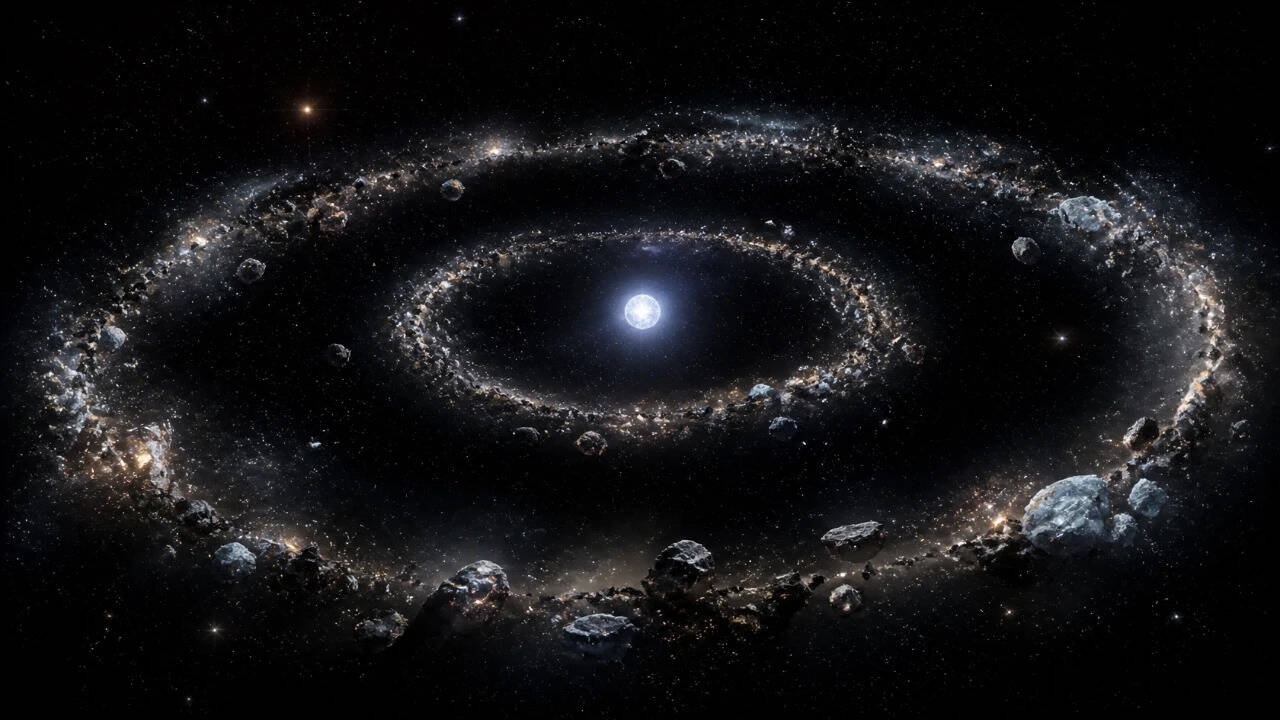
In a groundbreaking discovery, astronomers have identified two unique gaseous rings encircling the white dwarf star J1328-1450. Utilizing the Very Large Telescope in Chile, researchers explored the surrounding materials, indicating that some smaller planetary bodies likely survived the star's catastrophic end. Unlike previous findings, these rings display varied chemical compositions, shedding light on the planetary…
In brief
There is a rather innocent idea we, as children, have grown up listening to when it comes to death. What does the death of a star look like for the planets that have spent billions of years in its orbit? Astronomers are therefore looking up for answers of their own: what may survive when our Sun, our star, dies?According to an article published in Nature Astronomy on October 26, 2026, astronomers have identified two distinct gaseous rings of planetary debris around a dead star. The star in question is called J1328-1450.
This is the opening of the story, shared with credit to The Times of India — World. The rest of the report — with every detail — continues on the publisher’s website.
Continue reading at The Times of India — World ↗