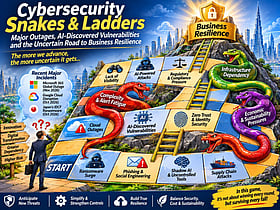
Organisations are investing in smarter cybersecurity, yet major technology outages, AI-accelerated vulnerability discovery and increasingly interconnected threats are creating an uncomfortable paradox: the more digitally advanced businesses become, the more uncertain their resilience appears.
Imagine playing a giant game of Snakes and Ladders, where every ladder represents a cybersecurity breakthrough and every snake represents an unexpected threat. You climb one step through AI-powered detection, Zero Trust or automation, only to slide backwards because of a newly discovered vulnerability, a cloud outage or an attack on a critical supplier.
Get updated faster and for FREE: Download the Gulf News app now - simply click here.
Welcome to the modern cybersecurity landscape, where the rules keep changing even while the game is in progress.
For years, organisations believed that deploying more security products, improving detection capabilities and moving infrastructure to the cloud would make them safer. Artificial intelligence has now accelerated this transformation. But it has also introduced a new dimension of uncertainty.
We are discovering vulnerabilities faster, detecting threats more intelligently, but are we becoming resilient at the same pace?
When the ladders suddenly become snakes
Recent major technology disruptions have demonstrated how fragile interconnected digital operations can become.
The November 2026 Microsoft 365 disruption, affecting services including Outlook, Teams and Copilot, illustrated how a technical infrastructure problem can interrupt business…