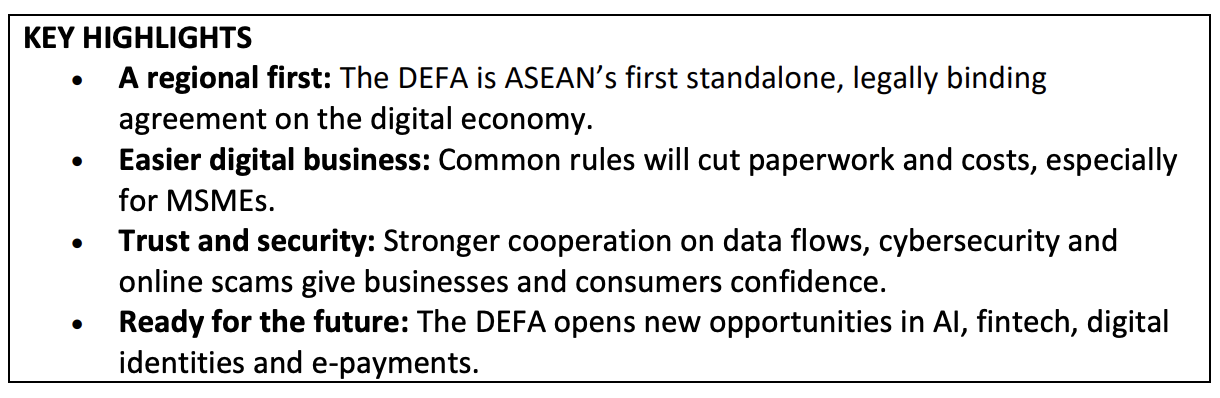
ASEAN’s new digital trade pact promises smoother cross-border commerce, yet the real test for Manila lies in proving that local merchants, exporters, and consumers actually capture the financial gains. To turn diplomatic momentum into measurable economic dividends, the Philippine government must close the treaty scrutiny gap, track hard commercial benchmarks, and address foundational infrastructure bottlenecks before declaring victory.
The Philippines has helped deliver a regional digital agreement, but its harder assignment is proving that a Filipino merchant will pay less to collect an overseas sale, an exporter will clear documents faster, and a consumer cheated across borders will have somewhere effective to turn.
Those everyday commercial transactions are the real test through which ASEAN’s diplomatic achievement must eventually enter the Philippine economy.
Economic ministers signed the ASEAN Digital Economy Framework Agreement, or DEFA, in Manila on Saturday, November 14, ahead of the leaders’ summit, a milestone confirmed by the ASEAN Secretariat.
Play Video
Signing gives participating governments a concrete diplomatic achievement to claim, yet businesses still need clarity on when specific obligations become effective, what domestic rules must change, and how compliance will be enforced across borders.
Singapore’s official factsheet describes DEFA as a legally binding agreement covering digital trade, cross-border payments, data protection, competition, and cybersecurity.