📰 Newspapers

Cambridge Dictionary pushes back on AI with ‘human’ as 2026 Word of the Year

Cambridge Dictionary pushes back on AI with ‘human’ as 2026 Word of the Year

'In a marketplace saturated with AI content, humans have started to become a premium that is code for intention, care, judgment, and the imperfections that make something feel real,' Cambridge Dictionary says

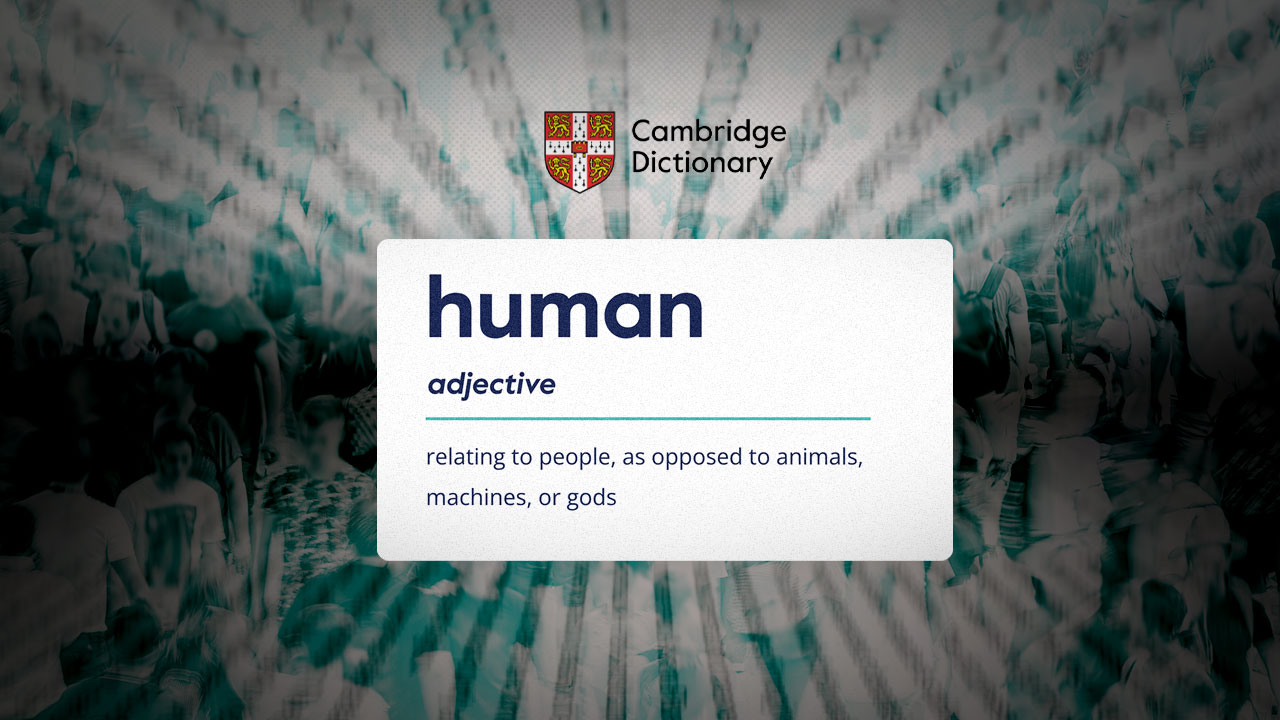
MANILA, Philippines – As artificial intelligence technologies grow more ubiquitous, Cambridge Dictionary designated “human” as its 2026 Word of the Year.

In a statement announcing their pick, the organization defined “human” in the Cambridge Dictionary as an adjective “relating to people, as opposed to animals, machines, or gods.”

“Throughout history, the adjective human has signified people, as opposed to animals and gods (and, more recently, machines). Increasingly seen in compounds such as human-written, human-generated, and human-made, it now also denotes that something is created by or typical of people as opposed to AI,” Cambridge Dictionary writes.

Cambridge Dictionary added that as AI-generated context becomes more commonplace, “simply saying that something was made by a person has started to gain new meaning.” The involvement of the human being becomes part of the value and is expressly more notable in a time when generative AI can produce things at speed and scale.

“In a marketplace saturated with AI content, humans have started to become a premium that is code for intention, care, judgment, and the imperfections that make something feel real,” Cambridge Dictionary said.

Colin McIntosh, Cambridge Dictionary chief editor, said of the choice: “Artificial intelligence has been a growing presence in society for years now, but this year it seemed to be everywhere.

In brief

MANILA, Philippines – As artificial intelligence technologies grow more ubiquitous, Cambridge Dictionary designated “human” as its 2026 Word of the Year. In a statement announcing their pick, the organization defined “human” in the Cambridge Dictionary as an adjective “relating to people, as opposed to animals, machines, or gods. Increasingly seen in compounds such as human-written, human-generated, and human-made, it now also denotes that something is created by or typical of people as opposed to AI,” Cambridge Dictionary writes.

This is the opening of the story, shared with credit to Rappler (Philippines). The rest of the report — with every detail — continues on the publisher’s website.

Continue reading at Rappler (Philippines) ↗

Cookie settings

Choose which cookies we may use. You can change this at any time from Cookie settings in the footer. Details of each cookie are in the Cookie Policy.

Strictly necessary

Needed for sign-in, security, payments and remembering these choices. Always on.

Preferences

Remember settings such as dark mode.

Analytics & performance

Help us count visits, understand which pages, devices and countries our readers use, and measure how well the site performs – anonymous and aggregated.

Advertising & marketing

Lets advertising partners show and personalise adverts, measure impressions, clicks and visits, prevent ad fraud and pay us – this is how the free site is funded.

🔔 News notifications

Get headlines from NewsHub on this device — even when the site is closed.

You can switch this off at any time. Works on Android, Windows, Mac and Linux browsers; on iPhone/iPad add the site to your Home Screen first.