

It is an adventure that perfectly embodies one of NASA's slogans, "Making the impossible possible" ("Rendre possible l'impossible"), and a historic milestone confirmed by the space agency: at this precise moment, 11:16 CET, Voyager 1 is about 25.9 billion kilometres from Earth. No human-made object has ever travelled so far. What is even more remarkable is that this grand old lady of space exploration is still operating, nearly 50 years after leaving our planet.A journey that began in 1977It all started on 5 September 1977 at the Cape Canaveral Space Center in Florida. Mounted on top of a powerful Titan IIIE-Centaur rocket, Voyager 1 broke away from Earth with an ambitious mission: to explore the giant planets of the solar system. Its twin, Voyager 2, had actually set off earlier, on 20 August. But Voyager 1 followed a faster trajectory and eventually overtook it.Today it is travelling at almost 61 000 km/h, about 17 kilometres per second. It gained this speed in particular thanks to the gravitational pull of the planets it flew past. In March 1979 it passed close to Jupiter, revealing its rings and the extraordinary volcanic activity on its moon Io. In November 1980 it flew over Saturn and carried out a close study of its spectacular rings and its moon Titan.But instead of continuing to explore…
Voyager 1 now 25.9 billion km from Earth, still active nearly 50 years after leaving our planet
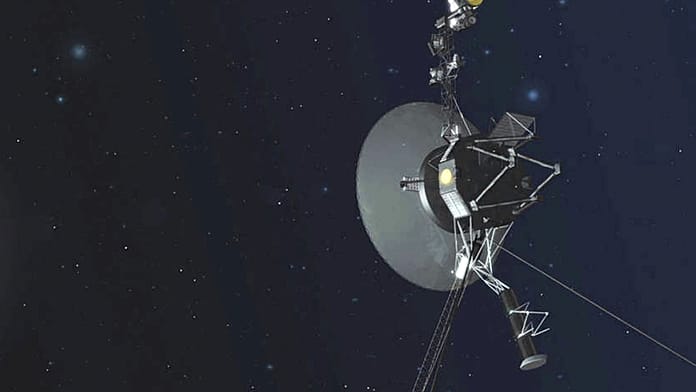
It set off at a time when mobile phones were still science fiction. Nearly half a century later, Voyager 1 continues its journey through space.
In brief
It is an adventure that perfectly embodies one of NASA's slogans, "Making the impossible possible" ("Rendre possible l'impossible"), and a historic milestone confirmed by the space agency: at this precise moment, 11:16 CET, Voyager 1 is about 25.9 billion kilometres from Earth. Mounted on top of a powerful Titan IIIE-Centaur rocket, Voyager 1 broke away from Earth with an ambitious mission: to explore the giant planets of the solar system.
This is the opening of the story, shared with credit to Euronews. The rest of the report — with every detail — continues on the publisher’s website.
Continue reading at Euronews ↗