

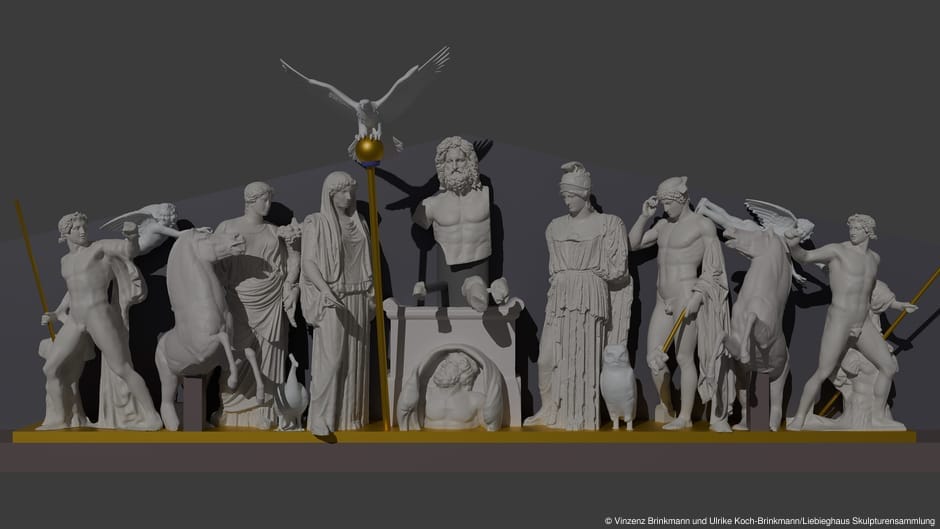
The 2,500-year-old Parthenon is ancient Greece's most important temple and is regarded as one of the greatest masterpieces of the High Classical period of Greek art.
Dedicated to Athena, the city's patron goddess, it towers over Athens from its position on the Acropolis — a powerful symbol of the city's importance.
The Parthenon had a lasting influence on Western ideas of humanity and art. The sculptures adorning its pediments, created under the direction of the legendary sculptor Phidias, are considered unparalleled examples of proportion and grace. They have influenced artists from ancient Rome through Neoclassicism to the modern era.
The east pediment above the temple entrance depicted the birth of the goddess Athena from the head of her father Zeus, surrounded by the Olympian gods. A total of 39 figures adorned the roughly 29-meter-long work of art. At its center stood a colossal Zeus figure, measuring 3.8 meters in height.
For centuries, scholars have puzzled over exactly what the arrangement looked like, as the pediment was destroyed during the Christianization of Greece.
After decades of painstaking detective work and with the help of modern technology, archaeologist Vinzenz Brinkmann and his team have managed to piece together all the surviving fragments of the Parthenon's east pediment.
Brinkmann heads the Antiquities and Asia department at Frankfurt's Liebieghaus sculpture collection.