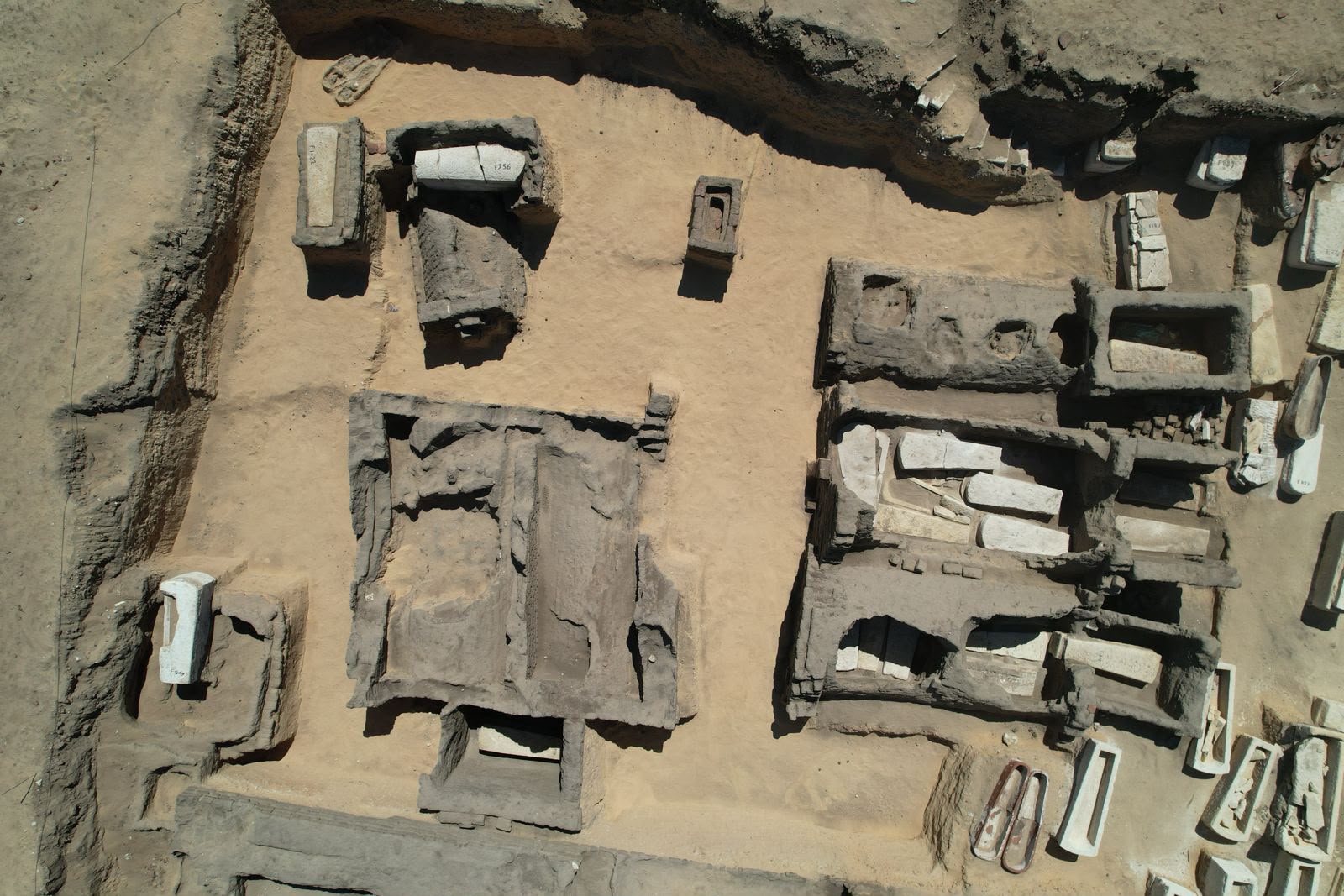
CAIRO: An Egyptian archaeological mission has uncovered an extensive necropolis containing hundreds of coffins and rare gold artifacts at Tell Kom Abu Billo in the northern governorate of Menoufia, the Ministry of Tourism and Antiquities said on Wednesday.
The tombs and burials date from the end of Egypt’s Late Period through the Ptolemaic era and into the early Roman period.
Among the finds were tongue-shaped gold pieces, jewelry, gold foil, scarabs and large numbers of faience ushabti figurines in various shapes and sizes.
The mission also discovered terracotta figurines depicting Isis-Aphrodite seated on a lotus flower, as well as small sphinx and Horus figures, amulets, offering tables and two falcon burials.
Mostafa Rizk, director-general of antiquities in Menoufia, said excavations had uncovered a surface layer containing hundreds of stone coffins. Some were missing their lids, while others had been badly damaged by previous looting and quarrying at the site.
Human remains found inside the coffins were in a poor state of preservation, he said. However, analysis revealed traces of mummification materials and resins, as well as fragments of painted cartonnage and plaster.
Rizk said the findings indicated that the burials had been prepared in accordance with ancient Egyptian religious beliefs and funerary practices.
The necropolis also contained pottery coffins, remnants of wooden coffins, vaulted mud-brick tombs and a tomb lined…