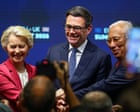
PM challenges rivals to rebuff plan he says could add 0.5% annual growth to economy and offer young people hope
Several sentences in to a slightly convoluted answer about where UK-EU relations might go next, Andy Burnham abruptly changed tack. “The important point is that Britain of today and the EU of today is not the one of 2016,” he said. “Life has moved on in so many ways.”
This is undoubtedly true. But Burnham’s political gamble on closer ties with Brussels hinges on the assumption that most British voters feel this way as well.
Seeking to push his deal on food checks, emissions trading and a new youth exchange scheme, Burnham was at first in full consumer politics mode, saying it would bring cheaper food – with a namecheck for Tesco, Asda and other supermarket chains – as well as lower electricity costs and a claimed 0.5% boost to overall growth.
But as the Brussels press conference went on, the prime minister became more misty-eyed, particularly in describing the youth exchange scheme as a gift to a generation stripped of choices by the 2016 referendum and then Covid. “Hope is a word,” he intoned. “And it starts now.”
For all that Burnham is a skilled political salesman, his oratory is backed up with some helpful political context matched with…