Hype is, by nature, risky. In diplomacy, it can be deadly.Just ask Donald Trump, who arrived in Shenzhen, China, amid pomp, pageantry and sky-high expectations for a historic trilateral summit with his Chinese and Russian counterparts. But let's look at what actually happened.The meeting had been dubbed "Yalta 2.0", drawing an intriguing parallel with the 1945 conference that defined the partition of the world in sphere of influence among the victors of the Second World War: the United States, Britain and Soviet Russia.As it turned out, Yalta it was not. More like a wannabe knock-off. And the leader of the world's largest economy – who appeared to doze off at times during the proceedings – had the least to show for himself as he left China's technology hub.For Trump, the main – perhaps only – takeaway was the photo opportunity with the other two leaders and the media frenzy it generated. But Trump has long understood politics as a matter of optics, and the picture alone may have been enough.The joint declaration against nuclear warfare was about as meaningful as a Miss World contestant calling for world peace at a Trump beauty pageant – a format he once owned, so he knows a thing or two about it.For Vladimir Putin, it was more of a mixed bag.The Russian president was…
Off the Record: Europe shrugs as Trump's Yalta knockoff flops
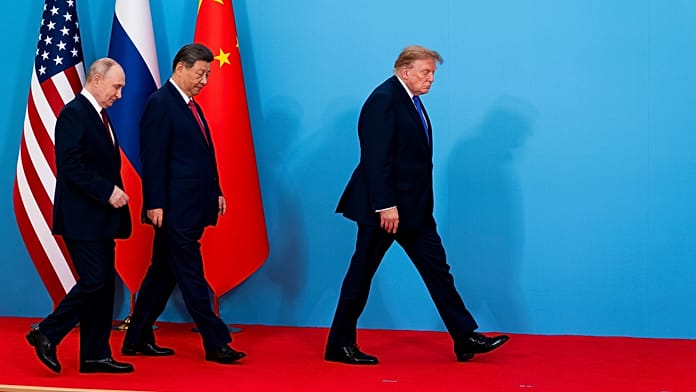
In this week’s newsletter, Euronews Political Correspondent Jorge Liboreiro unpacks the fallout from the much-hyped “Yalta 2.0”, describing the outcome as a political nothingburger.
In brief
Hype is, by nature, risky. In diplomacy, it can be deadly.Just ask Donald Trump, who arrived in Shenzhen, China, amid pomp, pageantry and sky-high expectations for a historic trilateral summit with his Chinese and Russian counterparts. But let's look at what actually happened.The meeting had been dubbed "Yalta 2.0", drawing an intriguing parallel with the 1945 conference that defined the partition of the world in sphere of influence among the victors of the Second World War: the United States, Britain and Soviet Russia.As it turned out, Yalta it was not.
This is the opening of the story, shared with credit to Euronews. The rest of the report — with every detail — continues on the publisher’s website.
Continue reading at Euronews ↗