A tiny skeleton has caused quite a stir in the paleontology world. Discovered in 2022, the fossil was found trapped inside a slab of sandstone in Wyoming, with only a few vertebrae visible to the people who unearthed it. The rest of the skeleton was hidden beneath the rock, leaving researchers with a rather unusual puzzle. Was it a baby dinosaur, a prehistoric snake or an early relative of crocodiles?Nearly four years later, scientists have managed to piece together much of the mystery using a combination of neutron and X-ray imaging. The study, titled Neutron and X-ray computed tomography reveals new early-branching choristoderes from the lower Morrison Formation of Wyoming, USA, was published in Royal Society Open Science on 18 November 2026.The scans revealed the previously unknown reptile lived around 156 million years ago, during the Jurassic period. Measuring approximately 45 centimetres from head to tail, the little creature had two unusual, horn-like projections at the back of its skull. Its discovery has also offered researchers new clues about the evolutionary relationships of an ancient group of reptiles whose origins have remained difficult to trace.A discovery in WyomingThe fossil was unearthed in August 2022 by an excavation team from Switzerland's Aathal Dinosaur Museum at Meilyn Quarry in Wyoming.
Scientists find 156-million-year-old horned reptile fossil in Wyoming sandstone
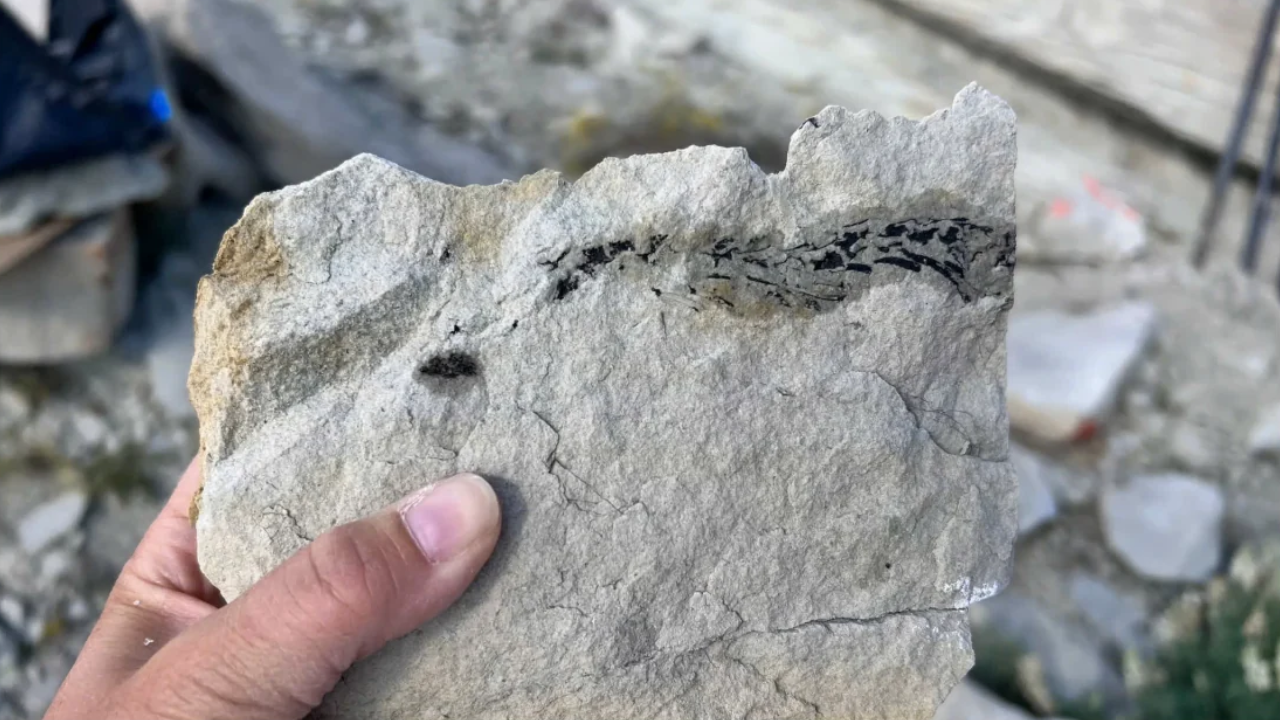
A remarkable discovery in Wyoming has unearthed a fossil of a diminutive dinosaur-like creature, dating back 156 million years to the Jurassic era. Advanced imaging techniques uncovered this skeleton entombed in sandstone. Researchers classify it as an early reptilian branch, enhancing our understanding of evolutionary history. Analysis indicates it inhabited freshwater environments and may have fallen prey to a…
In brief
A tiny skeleton has caused quite a stir in the paleontology world. Discovered in 2022, the fossil was found trapped inside a slab of sandstone in Wyoming, with only a few vertebrae visible to the people who unearthed it. The study, titled Neutron and X-ray computed tomography reveals new early-branching choristoderes from the lower Morrison Formation of Wyoming, USA, was published in Royal Society Open Science on 18 November 2026.The scans revealed the previously unknown reptile lived around 156 million years ago, during the Jurassic period.
This is the opening of the story, shared with credit to The Times of India — World. The rest of the report — with every detail — continues on the publisher’s website.
Continue reading at The Times of India — World ↗