📰 Newspapers

What is crawling on Rembrandt's 'The Night Watch'?

What is crawling on Rembrandt's 'The Night Watch'?

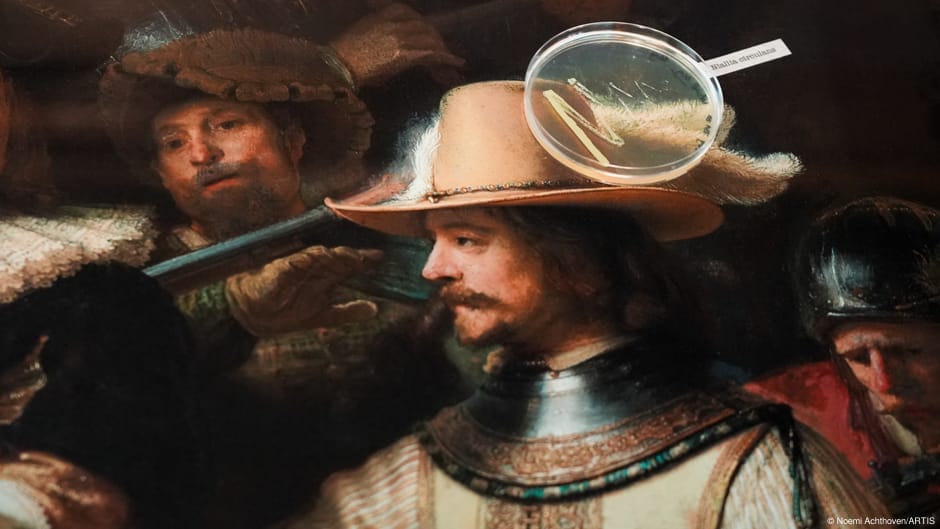
A new project and exhibition, "The Night Watch Lives," lifts the veil on the hidden world of microbes covering one of the most famous paintings of the Dutch Golden Age.

Rembrandt van Rijn's "The Night Watch" is one of the most famous paintings of the Dutch Golden Age. Amsterdam's Rijksmuseum, where the work is on display, hails the artist's 1642 masterpiece as "the turning point in his career and as the superlative example of his creative genius."

In the painting, Rembrandt made dramatic use of light and shadow to guide the viewer's eye to key figures. And unlike static group portraits typical of his era, the artist depicted Amsterdam's civic guards in mid-action, as they prepare to march out.

Beyond the sense of movement featured in "The Night Watch," the painting itself is also alive in a way that's rarely taken into consideration — through the microscopic organisms living on the canvas.

The research project "The Night Watch Lives" explores exactly that question: What kinds of life forms inhabit the surface of the famous painting?

The study is a collaborative scientific and exhibition project between the Rijksmuseum and ARTIS-Micropia — an Amsterdam museum dedicated to the world of microorganisms.

It's part of the broader "Operation Night Watch" restoration and research project described as the "biggest and most wide-ranging ever study and restoration of Rembrandt's most famous painting," started in 2019.

In brief

Rembrandt van Rijn's "The Night Watch" is one of the most famous paintings of the Dutch Golden Age. The research project "The Night Watch Lives" explores exactly that question: What kinds of life forms inhabit the surface of the famous painting? It's part of the broader "Operation Night Watch" restoration and research project described as the "biggest and most wide-ranging ever study and restoration of Rembrandt's most famous painting," started in 2019.

This is the opening of the story, shared with credit to DW — Top stories. The rest of the report — with every detail — continues on the publisher’s website.

Continue reading at DW — Top stories ↗

Cookie settings

Choose which cookies we may use. You can change this at any time from Cookie settings in the footer. Details of each cookie are in the Cookie Policy.

Strictly necessary

Needed for sign-in, security, payments and remembering these choices. Always on.

Preferences

Remember settings such as dark mode.

Analytics & performance

Help us count visits, understand which pages, devices and countries our readers use, and measure how well the site performs – anonymous and aggregated.

Advertising & marketing

Lets advertising partners show and personalise adverts, measure impressions, clicks and visits, prevent ad fraud and pay us – this is how the free site is funded.

🔔 News notifications

Get headlines from NewsHub on this device — even when the site is closed.

You can switch this off at any time. Works on Android, Windows, Mac and Linux browsers; on iPhone/iPad add the site to your Home Screen first.