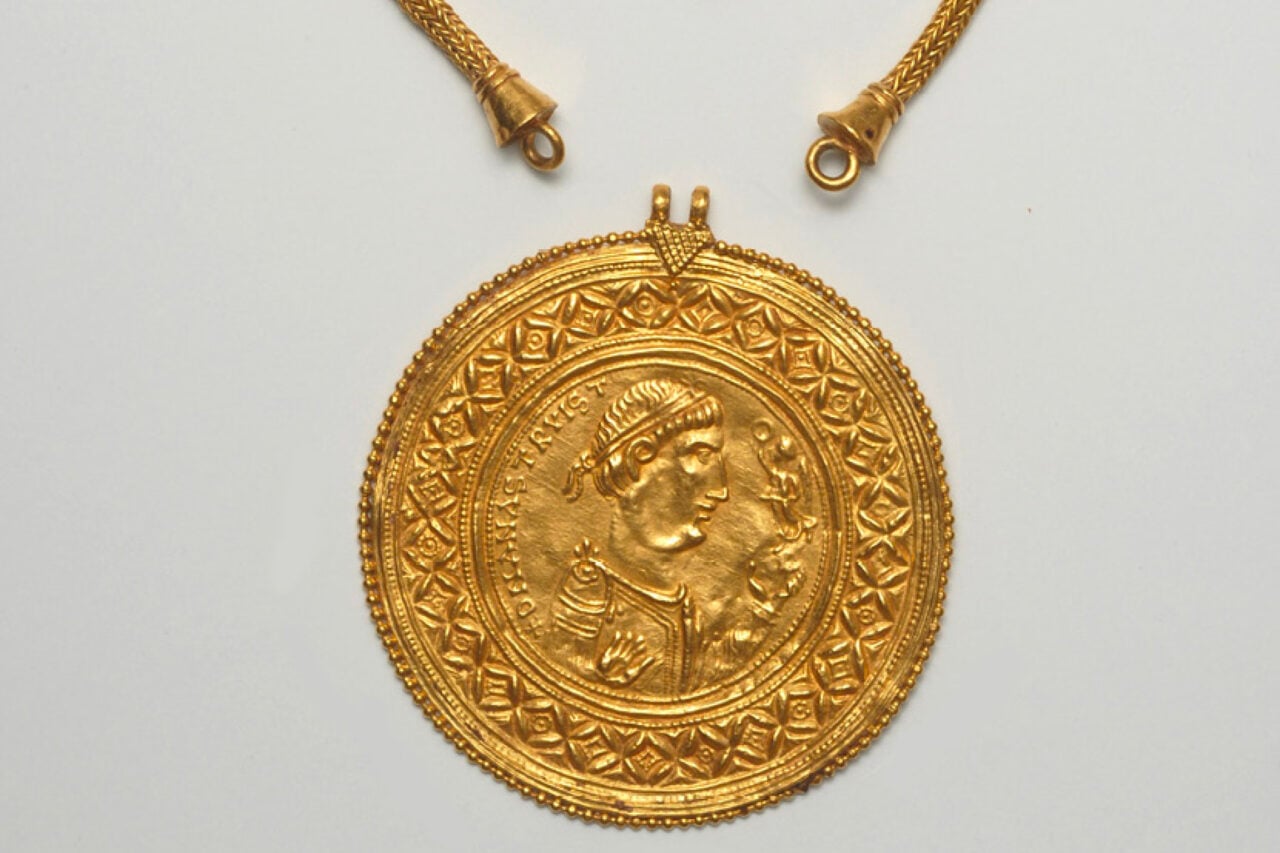
While browsing through the Dumbarton Oaks Museum in Washington D.C., medieval historian Marco Cristini stumbled upon a pendant composed of two golden medallions. Previous analysis had deemed these unofficial medallions of dubious value—but Cristini suspected something was off.
A new investigation by Cristini, published in the journal Frühmittelalterliche Studien, confirms his suspicions. The items were initially classified as “pseudo-medallions,” which were different from “true medallions” minted on behalf of Roman emperors and served a ceremonial function. The former were thought to be crafted in unofficial workshops and arguably had less value. However, Cristini’s research found evidence suggesting otherwise, including a specific moment in the early sixth century where the medallions were used by East Roman emperors as tools of “glittering diplomacy” and soft power to secure alliances, he explained to Gizmodo.
For the study, Cristini combined historical records with epigraphic analysis—a study of inscriptions and engravings on artifacts. Everything “clicked” when he identified a ruler of the Lazi—an ethnic group near the Black Sea—as the recipient of the medallion, and that the inscriptions were referring to this ruler, he told Gizmodo.
For a “pseudo-medallion,” the workmanship seen on these artifacts is exquisite. The medallions form a pendant around 3.4 inches (8.7 centimeters) across and are suspended from two braided gold chains.