

Court-appointed experts investigating the 18 January rail accident in Adamuz, Córdoba, Spain, in which 46 people were killed and more than 150 injured, point to a poorly executed weld and subsidence of the ground as the most likely causes of the disaster.In a preliminary expert report dated 20 November, the three engineers tasked with establishing the cause of the accident state that a 6.4-millimetre irregularity, detected in October 2025, may have contributed to the fracture of the rail that caused the Iryo train to derail and then collide with a Renfe Alvia. The experts warn, however, that outstanding tests could still alter their conclusions.A faulty weld and a track irregularity detected months earlierAccording to the experts, the sinking of one of the rails may have generated overloads on the opposite rail as trains continuously passed over it, progressively weakening the weld until it broke. The engineers call this phenomenon the 'seesaw effect'.The irregularity did not require trains to reduce speed, but it did call for closer monitoring and maintenance work. The experts say they have no evidence that such follow-up was carried out.The weld under investigation joined a rail manufactured in 1989 to another from 2023, installed during upgrade works on the Madrid-Seville high-speed line in 2025.
Badly welded rail and sinking ground likely caused deadly Spanish train crash, experts say
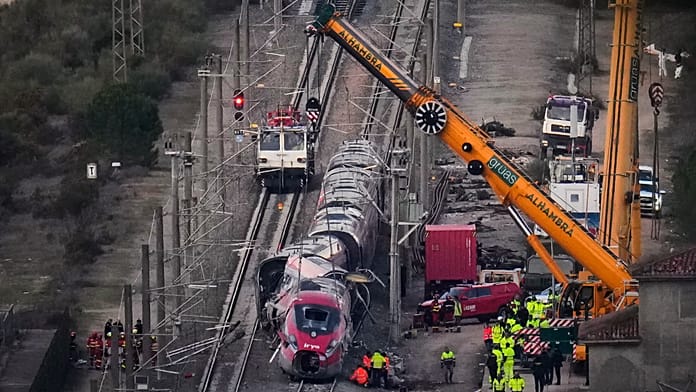
A track defect flagged three months before the derailment may never have been followed up, a preliminary report finds, though key tests are still outstanding.
In brief
Court-appointed experts investigating the 18 January rail accident in Adamuz, Córdoba, Spain, in which 46 people were killed and more than 150 injured, point to a poorly executed weld and subsidence of the ground as the most likely causes of the disaster.In a preliminary expert report dated 20 November, the three engineers tasked with establishing the cause of the accident state that a 6.4-millimetre irregularity, detected in October 2025, may have contributed to the fracture of the rail that caused the Iryo train to derail and then collide with a Renfe Alvia.
This is the opening of the story, shared with credit to Euronews. The rest of the report — with every detail — continues on the publisher’s website.
Continue reading at Euronews ↗