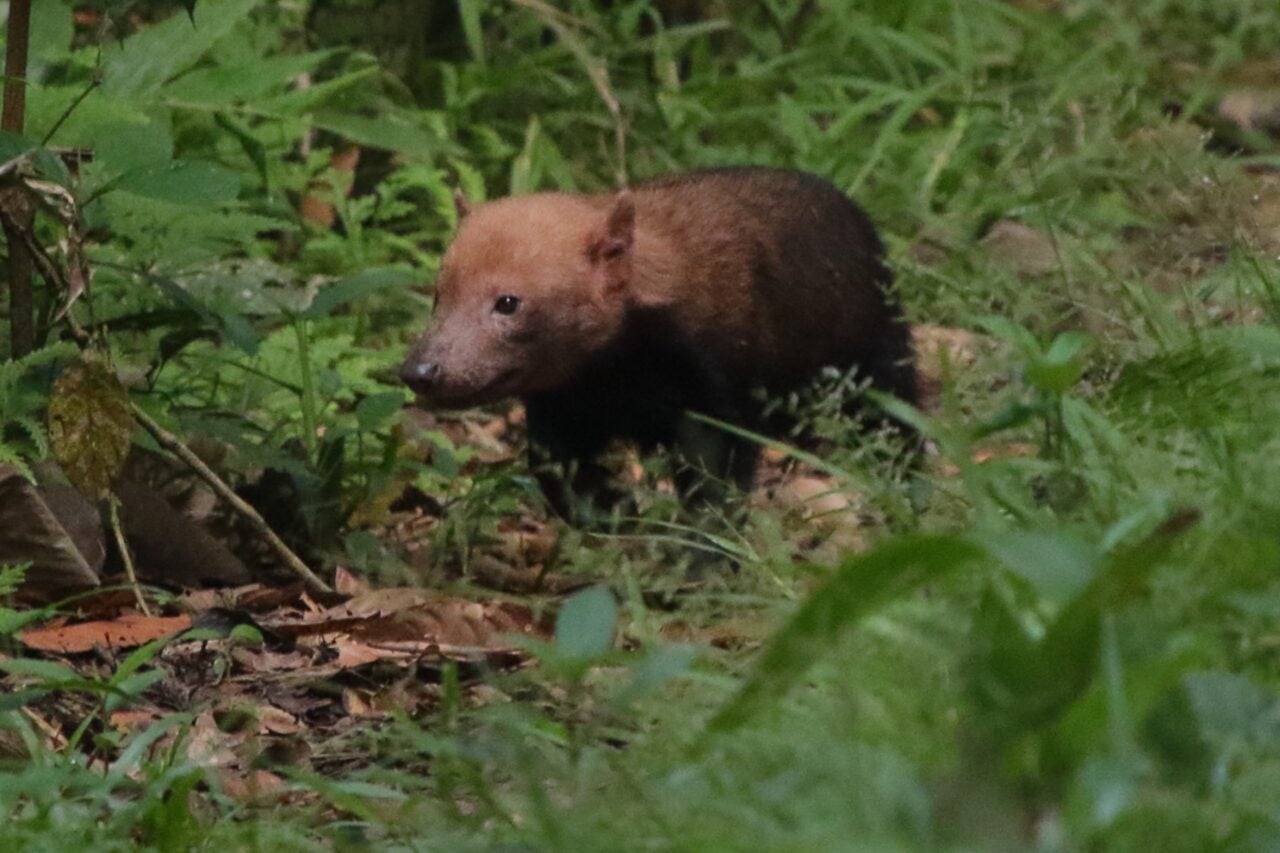
South and Central America’s bush dog (Speothos venaticus) is almost cryptid-level rare. Sightings are so rare, in fact, that the man who first identified the bush dog from the bones he uncovered inside Brazilian caves, 19th century Danish paleontologist Peter Wilhelm Lund, simply presumed that he’d found the fossils of a new extinct canine.
Now—thanks to 25 years’ worth of camera-trap data recorded at 97 sites across seven different South American countries—wildlife biologists have a better sense of just how exceedingly rare the endearing, roughly 15-pound (7-kilogram) little bush dog really is. The answer is incredibly rare. Across over 2.1 million photographs snapped over 611,159 local “camera-trap nights,” according to researchers with the international Wildlife Conservation Society (WCS), the pint-sized S. venaticus appeared on just 12 occasions at 12 sites.
That curious lack of on-site repeats speaks to the bush dog’s sprawling range, from Costa Rica down to the northeastern reaches of Argentina. Robert Wallace, a senior conservation scientist at WCS, and his colleagues said that they compared the bush dog sightings to other images from these camera-traps that recorded other similarly “widely distributed” South American carnivores for better context.
“Relative abundance indices for bush dogs were approximately 50 times lower than those of the short-eared dog Atelocynus microtis, 100 times lower than those of jaguar Panthera onca, and nearly…