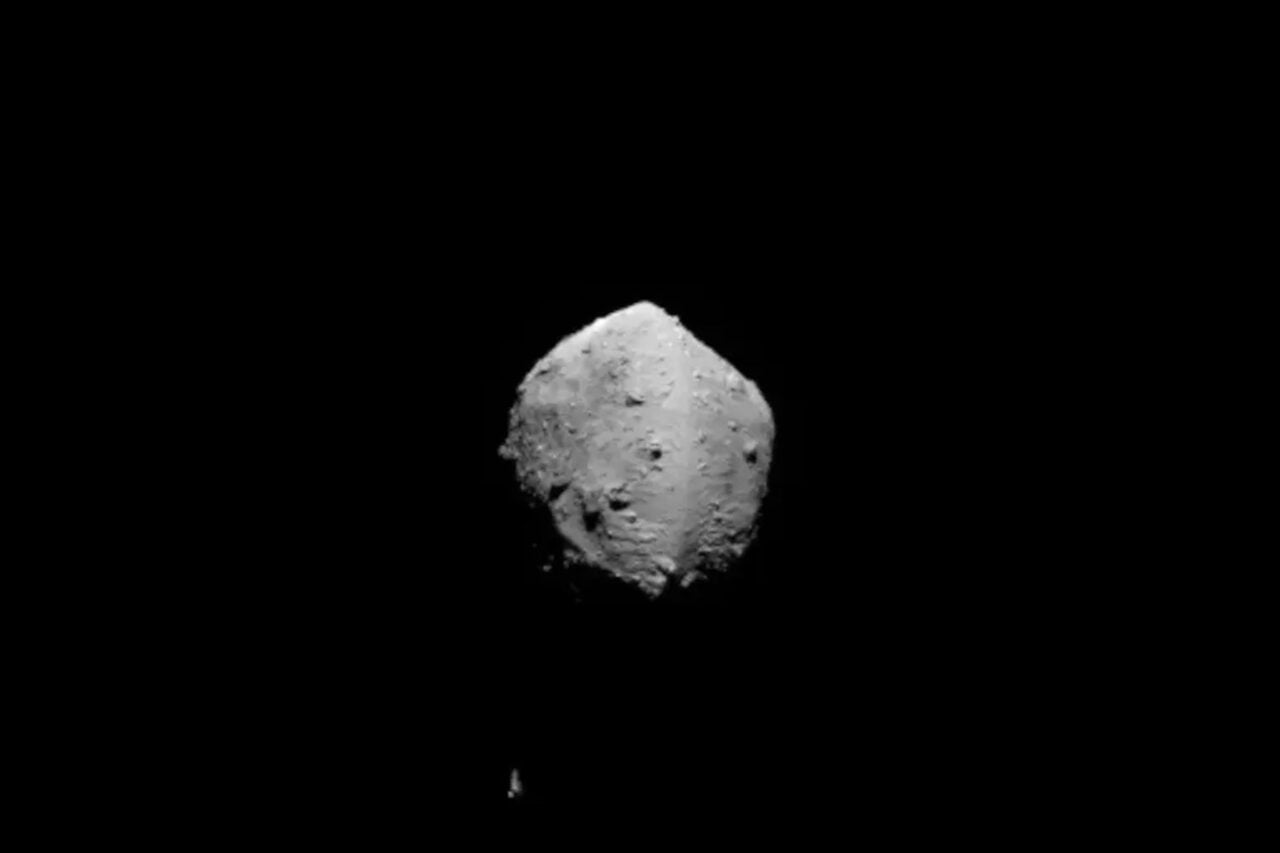
Four years ago, NASA made history by deliberately crashing a spacecraft into an asteroid. The experiment was a first-of-its-kind test of planetary defense, designed to see whether humanity could alter the trajectory of a space rock before it ever threatened Earth. But the entire story of what happened has yet to be told.
Now, the European Space Agency’s (ESA) Hera spacecraft has arrived at the scene. Its mission is to investigate the aftermath of NASA’s DART collision, getting up close to the asteroid and documenting the changes left behind.
ESA is revealing the first close-up images captured by Hera on Wednesday at 1:45 p.m. ET, allowing us to see just what a spacecraft-sized punch can do to a space rock. The event will be live-streamed on ESA’s WebTV, as well as the space agency’s YouTube channel. You can also tune in through the feed below.
NASA’s Double Asteroid Redirection Test (DART) was designed to test whether a spacecraft could deflect an asteroid by deliberately crashing into it. Its target was Dimorphos, a 558-foot-wide (170-meter) space rock that orbits its larger 2,625-foot-wide (800-meter) companion, Didymos. Together, the pair form a binary asteroid system.
On September 26, 2022, DART slammed into the asteroid at approximately 14,000 miles per hour (22,500 kilometers per hour).