

The images taken by the Hera mission show that the 151 metre diameter object, called Dimorphos, has one side that has been transformed by the impact of the American probe named DART. Dimorphos orbits around a larger asteroid called Didymos, which is clearly visible in the foreground of the pictures, and the pair were chosen for investigation because they pose no threat to our planet. The new images, with a resolution of 2.7 metres per pixel, show a massive impact zone that's unlike anything scientists have seen up close before.Patrick Michel, Principal Investigator on the European Space Agency (ESA) mission tells Euronews, "It's a huge crater, yet it didn't destroy the object, and there are things in the middle of it that we still don't understand." Surprisingly, hundreds of lumps of debris of up to a metre in size are now floating around the asteroid, too. "It's complete chaos," Hera Project Manager Ian Carnelli tells Euronews. "It's completely different from what our brain would tell us rationally that these rocks should look like and behave."This is the first time that a spacecraft made by humans has actually impacted an interplanetary body with the direct intention of altering its course. Right now, Dimorphos appears to be reeling chaotically like a boxer after a powerful punch."Its rotation around its own axis is…
ESA releases first images showing 'complete chaos' on asteroid smashed by NASA probe
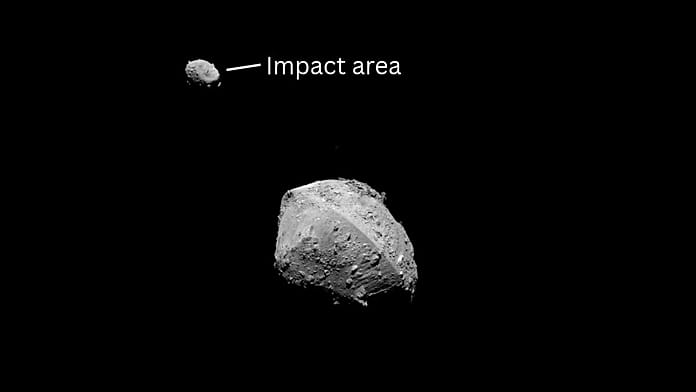
The European Space Agency's first images of the asteroid deliberately smashed by NASA's Dart mission show a huge impact zone with hundreds of rocks drifting near the surface. Is this how we should defend our planet?
In brief
The images taken by the Hera mission show that the 151 metre diameter object, called Dimorphos, has one side that has been transformed by the impact of the American probe named DART. Dimorphos orbits around a larger asteroid called Didymos, which is clearly visible in the foreground of the pictures, and the pair were chosen for investigation because they pose no threat to our planet. "It's complete chaos," Hera Project Manager Ian Carnelli tells Euronews.
This is the opening of the story, shared with credit to Euronews. The rest of the report — with every detail — continues on the publisher’s website.
Continue reading at Euronews ↗