📰 Newspapers

Anne Carson’s ‘How Not to Read a Poem’ published in Persian

Anne Carson’s ‘How Not to Read a Poem’ published in Persian

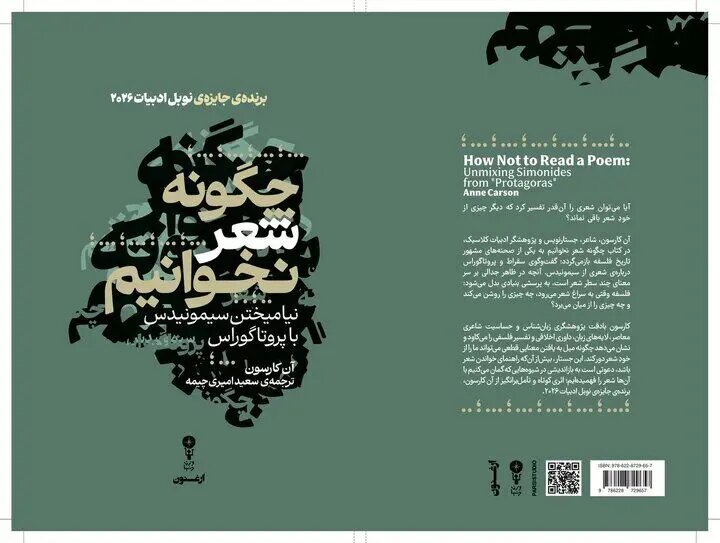
TEHRAN- “How Not to Read a Poem,” an essay by Canadian poet and 2026 Nobel laureate Anne Carson, has been published in Persian in a translation by Saeed Amiri Chimeh.

The 56-page book has been released in the Arghanoon collection by Vazn-e Donya Publications in Tehran.

Originally published in 1992 in the academic journal “Classical Philology”, the essay examines a philosophical exchange between Socrates and Protagoras in Plato’s dialogue “Protagoras.” Their discussion centers on a poem by Simonides of Ceos, an ancient Greek lyric poet, and the ways in which its meaning can be interpreted.

In Plato’s dialogue, Socrates and Protagoras attempt to analyze Simonides’ poem through philosophical argument, examining its language and the apparent contradictions in its statements. Carson revisits this exchange to explore the complicated relationship between poetry and philosophical interpretation.

Rather than treating the poem as a text with a single, easily identifiable meaning, Carson examines how the philosophers’ efforts to explain it can lead them away from the poetry itself. Their discussion, she suggests, exposes the limitations of imposing a rigid philosophical framework on poetic language.

Drawing on her background in classical languages and literature, Carson approaches the subject with both the precision of a scholar and the sensitivity of a poet.

In brief

TEHRAN- “How Not to Read a Poem,” an essay by Canadian poet and 2026 Nobel laureate Anne Carson, has been published in Persian in a translation by Saeed Amiri Chimeh. Originally published in 1992 in the academic journal “Classical Philology”, the essay examines a philosophical exchange between Socrates and Protagoras in Plato’s dialogue “Protagoras. Carson revisits this exchange to explore the complicated relationship between poetry and philosophical interpretation.

This is the opening of the story, shared with credit to Tehran Times. The rest of the report — with every detail — continues on the publisher’s website.

Continue reading at Tehran Times ↗

Cookie settings

Choose which cookies we may use. You can change this at any time from Cookie settings in the footer. Details of each cookie are in the Cookie Policy.

Strictly necessary

Needed for sign-in, security, payments and remembering these choices. Always on.

Preferences

Remember settings such as dark mode.

Analytics & performance

Help us count visits, understand which pages, devices and countries our readers use, and measure how well the site performs – anonymous and aggregated.

Advertising & marketing

Lets advertising partners show and personalise adverts, measure impressions, clicks and visits, prevent ad fraud and pay us – this is how the free site is funded.

🔔 News notifications

Get headlines from NewsHub on this device — even when the site is closed.

You can switch this off at any time. Works on Android, Windows, Mac and Linux browsers; on iPhone/iPad add the site to your Home Screen first.