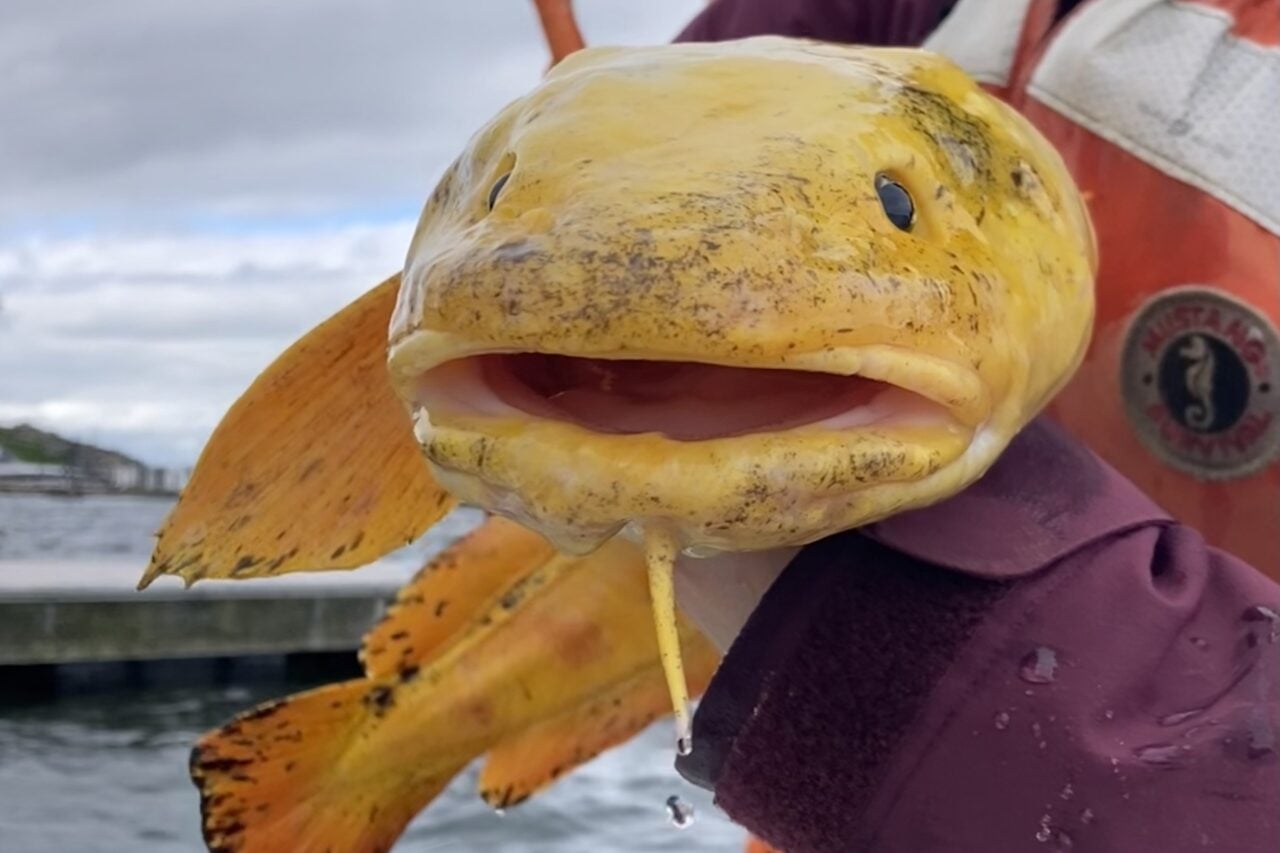
During a routine survey in New York’s Oswega Harbor, a team of biologists got a little more color than they bargained for: an unusually vivid burbot that looks like it had been dipped in orange sherbet.
Biologists with the U.S. Fish and Wildlife Service (USFWS) caught the rare native fish last month while surveying the Oswego Harbor for invasive species. Its discovery highlights the effectiveness of their efforts to detect non-native species in the harbors, rivers, and embayments of the Great Lakes, according to USFWS.
The burbot population in Oswego Harbor is extremely low, and the species typically inhabits deeper, cooler waters. This burbot’s color also makes it an exceptionally rare find. The fish has a rare genetic condition that suppresses its normal pigmentation, resulting in the bright orange-yellow color.
Burbot (Lota lota) have elongated bodies, broad, flattened heads, and a single whisker-like barbel dangling from their lower jaw. This little appendage helps them sense their surroundings and locate food.
Their usual coloration is quite different from the bright yellow-orange fish caught in Oswego. They’re typically olive, brown, or dark green, with mottled markings and a pale belly. The recently caught burbot looks more like an overgrown goldfish due to xanthochromism, a rare biological condition caused by a genetic mutation that suppresses normal pigmentation and produces a yellow-orange appearance.