

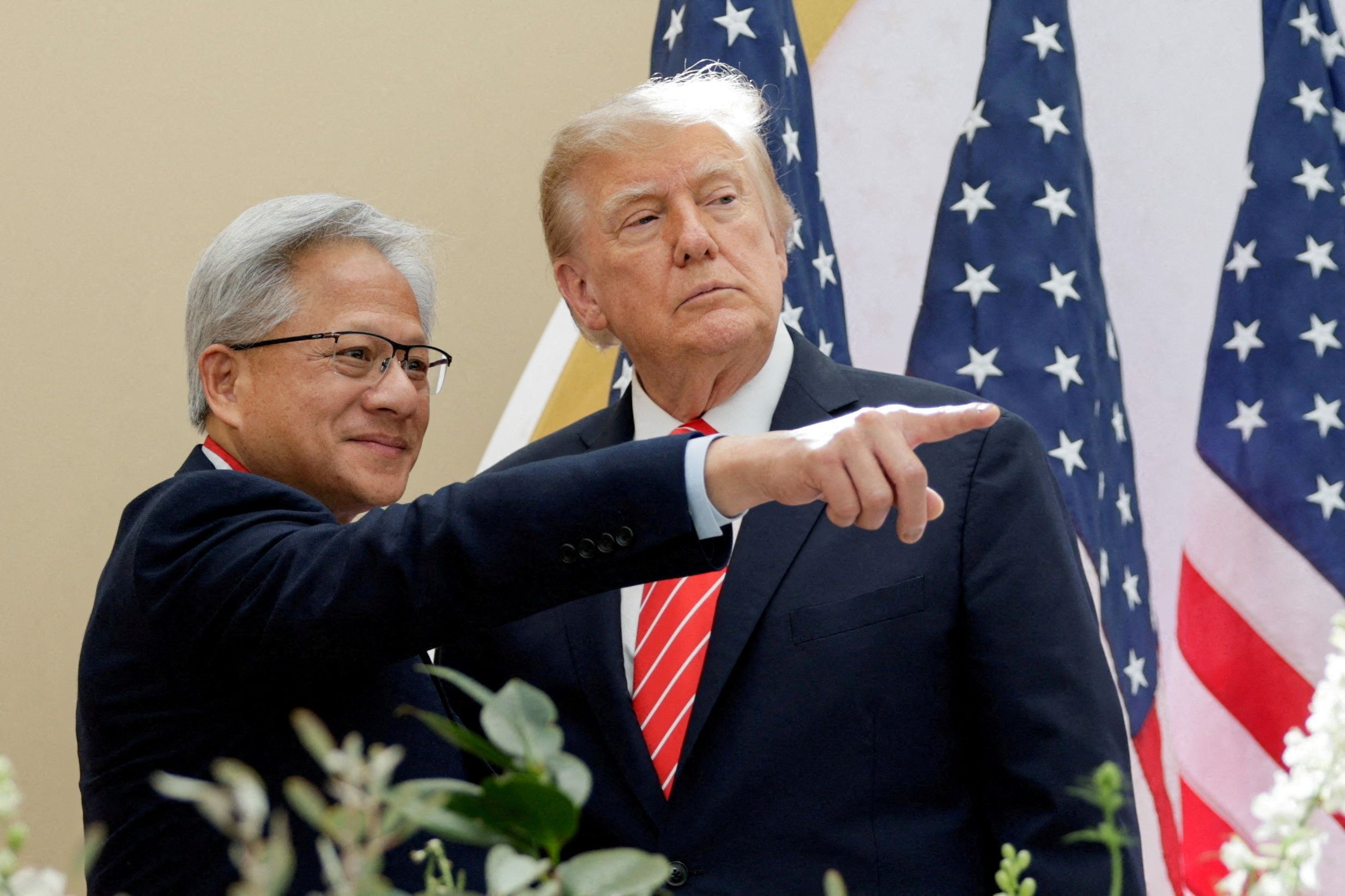
To be a China “hawk,” Jensen Huang declared last year, is a “badge of shame.”
The former Nvidia CEO was a proud dove, one who found a dovish partner in US President Donald Trump — quite literally, in a business sense. Together, they formed an enterprise that aimed to sell high-end Nvidia chips to China, with the US government taking a cut of the profits.
Their alliance represented the high-water mark of a Sino-US détente — peak dovishness, where a prime consideration in the White House was expanding Nvidia’s market share, not blocking China’s AI ambitions. Asked on CNN if it mattered who won the AI superpower race, Huang replied “I don’t think it does.”
That moment has come and gone. A trade that not only sent powerful chips into China via legal channels, but also billions of dollars of hardware illicitly through Chinese-funded companies in Southeast Asia — one of the most active, Megaspeed, set up by a suspected Chinese intelligence asset with whom Huang was having an affair — has run headlong into the hard realities of US-China strategic competition.
Their superpower rivalry is structural. Its main focus is technology and, whatever Huang says, AI has made the struggle existential.
At times, Trump has seemed confused about the geostrategic stakes.