📰 Newspapers

Rights court rules Turkey must release jailed lawmaker Atalay

Rights court rules Turkey must release jailed lawmaker Atalay

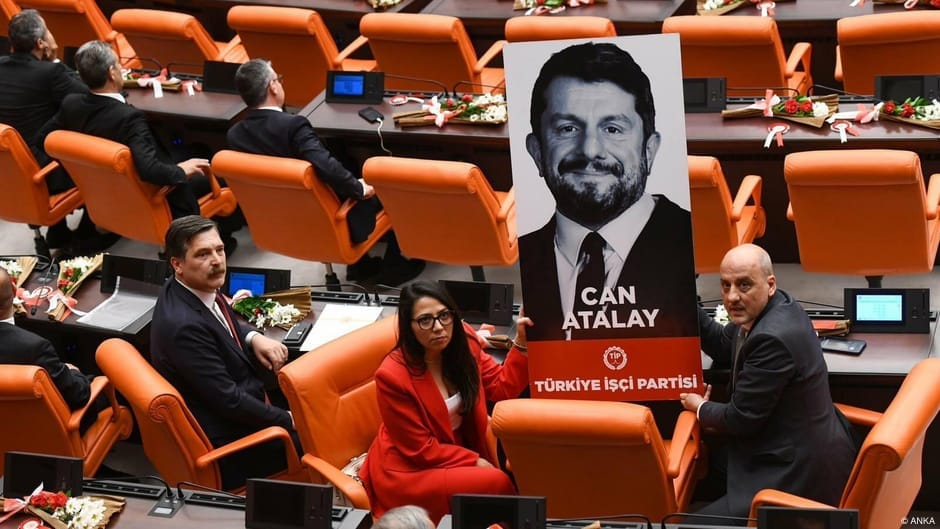
The European Court of Human Rights has called for the release of imprisoned elected lawmaker Can Atalay. Atalay has been in prison for almost five years despite rulings from the Turkish Constitutional Court.

The European Court of Human Rights (ECHR) ruled against Turkey over the detention of human rights lawyer and elected lawmaker Can Atalay.

The ECHR published its decision on Tuesday, saying that Turkey must release Atalay and allow him to take up his seat in the Turkish parliament.

The court ruled that his continued detention had been intended to silence him and undermine political pluralism.

It ordered Turkey to pay him €32,500 (about $35,700) in compensation.

The judges stressed that Atalay's case should not be considered separately, but rather in the wider context of the detention of political opponents, human rights activists and journalists in Turkey.

To view this video please enable JavaScript, and consider upgrading to a web browser that supports HTML5 video

Turkey was among the original signatories of the European Convention on Human Rights. Yet it has previously refused to comply with the court's decisions in the cases of rights activist Osman Kavala and prominent Kurdish politician Selahattin Demirtas.

As a lawyer, Atalay represented victims in numerous social and political cases in Turkey, as well as in freedom of speech cases involving journalists and writers.

He was also among the leading voices in the 2013 Gezi protests, which the government called an attempted coup.


In brief

The European Court of Human Rights (ECHR) ruled against Turkey over the detention of human rights lawyer and elected lawmaker Can Atalay. The judges stressed that Atalay's case should not be considered separately, but rather in the wider context of the detention of political opponents, human rights activists and journalists in Turkey. As a lawyer, Atalay represented victims in numerous social and political cases in Turkey, as well as in freedom of speech cases involving journalists and writers.

This is the opening of the story, shared with credit to DW — Top stories. The rest of the report — with every detail — continues on the publisher’s website.

Continue reading at DW — Top stories ↗

Cookie settings

Choose which cookies we may use. You can change this at any time from Cookie settings in the footer. Details of each cookie are in the Cookie Policy.

Strictly necessary

Needed for sign-in, security, payments and remembering these choices. Always on.

Preferences

Remember settings such as dark mode.

Analytics & performance

Help us count visits, understand which pages, devices and countries our readers use, and measure how well the site performs – anonymous and aggregated.

Advertising & marketing

Lets advertising partners show and personalise adverts, measure impressions, clicks and visits, prevent ad fraud and pay us – this is how the free site is funded.

🔔 News notifications

Get headlines from NewsHub on this device — even when the site is closed.

You can switch this off at any time. Works on Android, Windows, Mac and Linux browsers; on iPhone/iPad add the site to your Home Screen first.