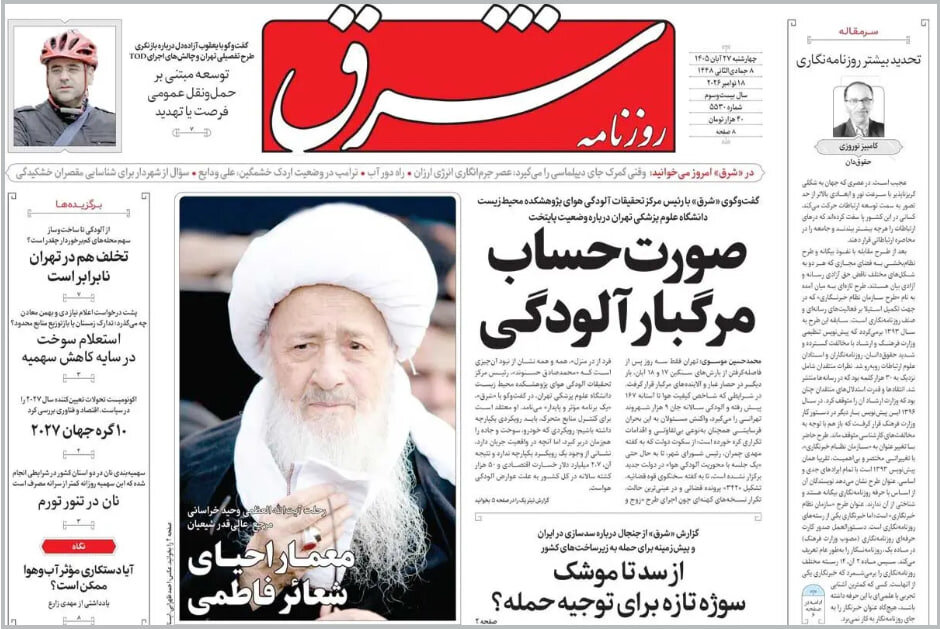
Shargh assessed the final two years of President Donald Trump’s term, arguing that congressional constraints on domestic policy may push him to focus on foreign affairs. In this context, Iran is expected to remain a central priority. According to the paper, Trump’s failure to achieve his objectives during the 40-day conflict likely demonstrated that regime change cannot be accomplished through remote air campaigns alone.
As a result, he is unlikely to repeat the same strategy. The newspaper nevertheless warns that another major confrontation remains possible if Benjamin Netanyahu’s political camp stays in power. If large-scale war is avoided, a more important question concerns how Iran would respond to tighter economic and transportation restrictions. Shargh argues that attempts to increase pressure through maritime measures and pressure on neighboring states could leave Tehran facing difficult choices. Should Iranian leaders conclude that such conditions are unsustainable, regional tensions could enter a new phase marked by greater uncertainty.
The Iran newspaper focused on the ECO foreign ministers’ meeting in Islamabad. It argued that Washington is trying to increase pressure on Tehran through economic measures and restrictions on important transportation routes. However, the paper stressed that geography and regional economic realities cannot be reshaped by unilateral decisions.