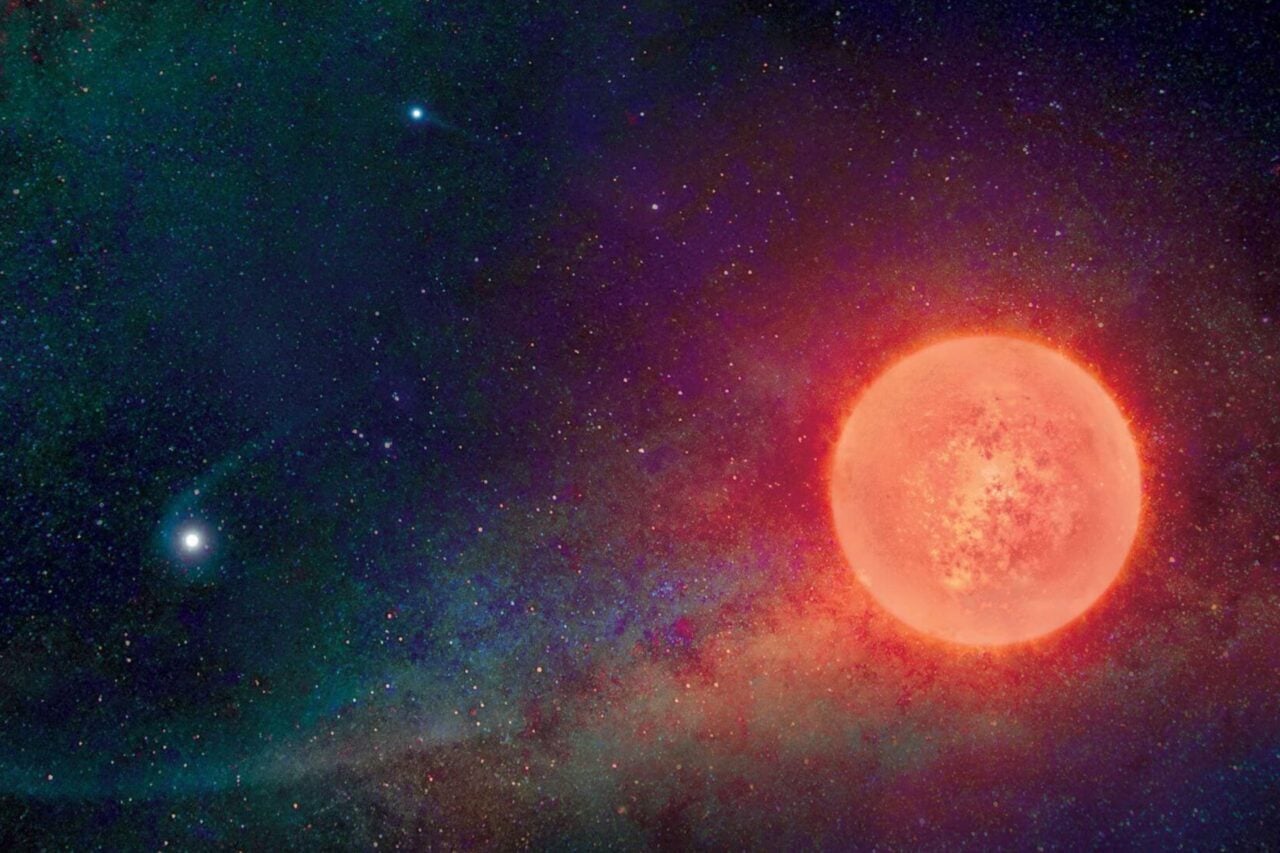
Astronomers noticed something odd while hunting for exoplanets in a star system just 28 light-years away from Earth. A powerful gravitational force was tugging mightily at the red dwarf star at the heart of this system, inducing whipsaw variations to its velocity by nearly 10 miles per second (16 kilometers per second)—over one thousand times larger than anticipated.
It took years of observations, but astronomers have now traced this red dwarf’s puzzling movements to a star system unlike anything they’ve ever seen in our region of the galaxy: a triple star system with a tightly intertwined white and red dwarf pair at its center, orbited by another white dwarf at a distance.
The tight dance of this system’s central pair didn’t make sense, the researchers said, given what the white dwarf must have been in its prior stage—a swollen giant big enough to reach its partner. The two stars should have spiraled together and fused into a single star long ago.
“This system should not exist,” study coauthor Patrick Dufour, an astrophysicist at the University of Montreal, said in a press statement. “We have no clean explanation for how it got here.”
Astronomers first noticed something odd about the red dwarf at the heart of Welopōʻai (“path of family traits”