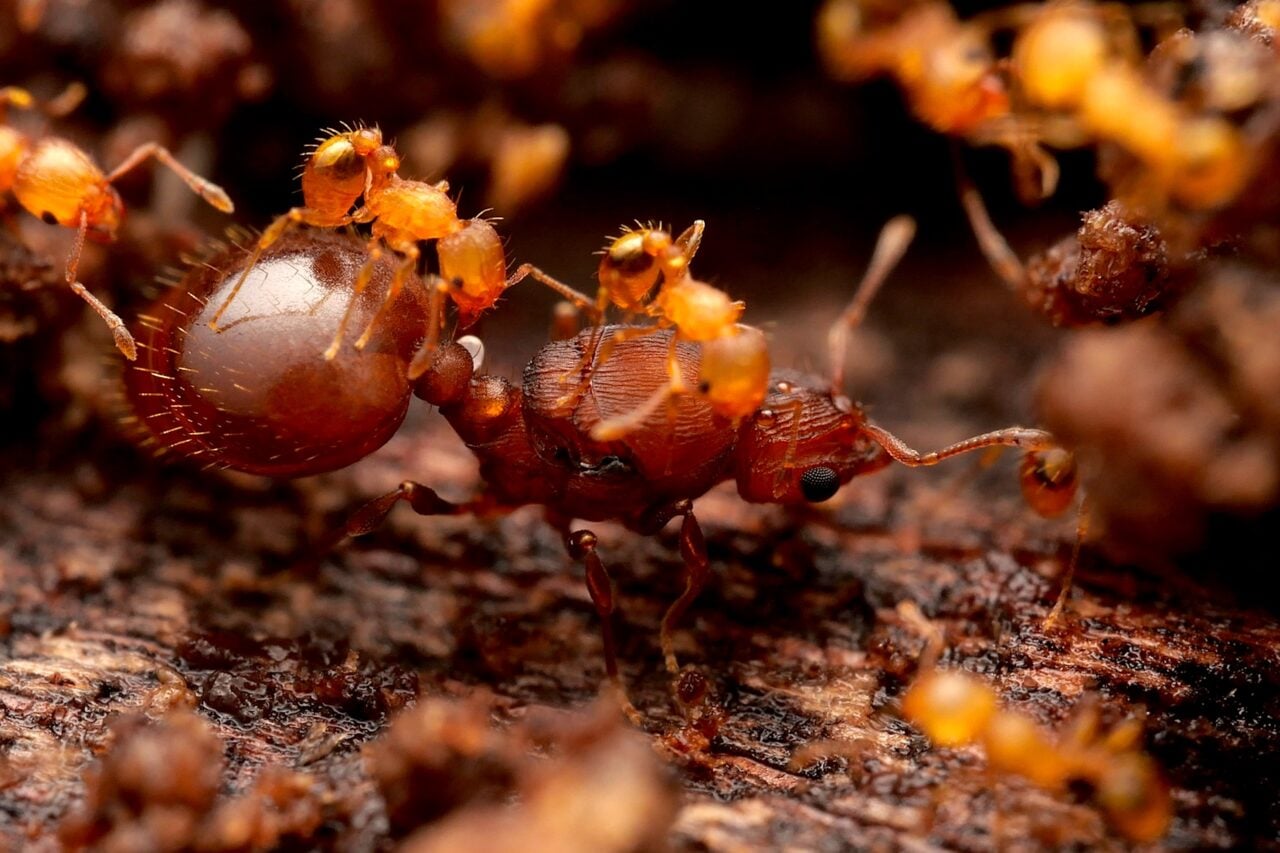
For an insect just one sixteenth of an inch (1.5 millimeters) long, the little fire ant (Allomerus auropunctatus, or formerly Wasmannia auropunctata) is genuinely ferocious. The searing sting from this invasive species is reportedly potent enough to cause blinding “cornea trauma” in creatures many orders of magnitude larger than itself, including elephants.
But the little fire ant saves its most devious stratagems for its rival invasive ant species, like the red imported fire ant (Solenopsis invicta) against which it is now vying for space around the coastal province of Guangdong in southern China. A study comprised of over 150 ant combat experiments, conducted by entomologists at South China Agricultural University’s Laboratory of Quarantine and Invasive Pests, has uncovered two decisive tactics that A. auropunctatus uses to best S. invicta. The little fire ant overwhelms its fellow invader when it knows it has the numerical advantage, but plays dead when outnumbered, a gambit the researchers call “thanatosis.”
“While intermediate interactions (avoidance, threat displays) were observed, our analysis specifically quantified the frequency of thanatosis to confirm it as a primary defensive node,” the lab’s leader, Yijuan Xu, and his colleagues explained this month in the journal Proceedings of the Royal Society B: Biological Sciences.
These strategies, they argue, help explain how S. invicta—a species whose workers can grow up to 0.2 inches…