📰 Newspapers

Scientists discover quasar formed 630 million years after the Big Bang

Scientists discover quasar formed 630 million years after the Big Bang

Scientists are seeing the quasar as it was 13.1 billion years ago — when the universe was less than 5% of its current age.

Researchers at the European Space Agency on Tuesday announced the discovery of the most distant, and therefore oldest, quasar ever observed.

The discovery, made by a German astronomer and his team, was published in the journal Astronomy and Astrophysics.

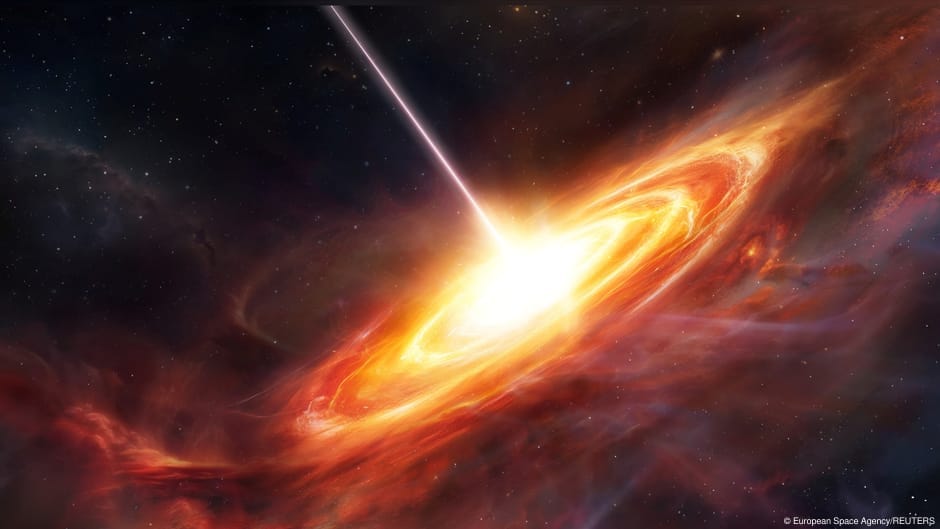
A quasar refers to an extremely bright core of an active galaxy powered by gas falling into a supermassive black hole.

Quasars represent a brief phase in a galaxy's life, during which the nucleus can outshine the rest of the system.

"As enormous amounts of gas, dust and matter fall toward the black hole, they form a swirling accretion disk that heats up to extreme temperatures and radiates tremendous amounts of energy, outshining the entire rest of the galaxy by factors of hundreds or even thousands," said astronomer and study co-author Silvia Belladitta of ​the Max Planck Institute for Astronomy in Germany and the INAF Bologna Observatory of Astrophysics and Space Science in Italy.

"This makes quasars visible across billions of light-years, allowing us to observe ​them from the very early universe. Studying quasars helps astronomers understand how the first galaxies formed and evolved, and how the supermassive black holes at their hearts grew to such enormous sizes," Belladitta said.

The newly discovered object, formally known as J1504+6252, is nicknamed Dún Aonghas.

In brief

Researchers at the European Space Agency on Tuesday announced the discovery of the most distant, and therefore oldest, quasar ever observed. A quasar refers to an extremely bright core of an active galaxy powered by gas falling into a supermassive black hole. Studying quasars helps astronomers understand how the first galaxies formed and evolved, and how the supermassive black holes at their hearts grew to such enormous sizes," Belladitta said.

This is the opening of the story, shared with credit to DW — Top stories. The rest of the report — with every detail — continues on the publisher’s website.

Continue reading at DW — Top stories ↗

Cookie settings

Choose which cookies we may use. You can change this at any time from Cookie settings in the footer. Details of each cookie are in the Cookie Policy.

Strictly necessary

Needed for sign-in, security, payments and remembering these choices. Always on.

Preferences

Remember settings such as dark mode.

Analytics & performance

Help us count visits, understand which pages, devices and countries our readers use, and measure how well the site performs – anonymous and aggregated.

Advertising & marketing

Lets advertising partners show and personalise adverts, measure impressions, clicks and visits, prevent ad fraud and pay us – this is how the free site is funded.

🔔 News notifications

Get headlines from NewsHub on this device — even when the site is closed.

You can switch this off at any time. Works on Android, Windows, Mac and Linux browsers; on iPhone/iPad add the site to your Home Screen first.