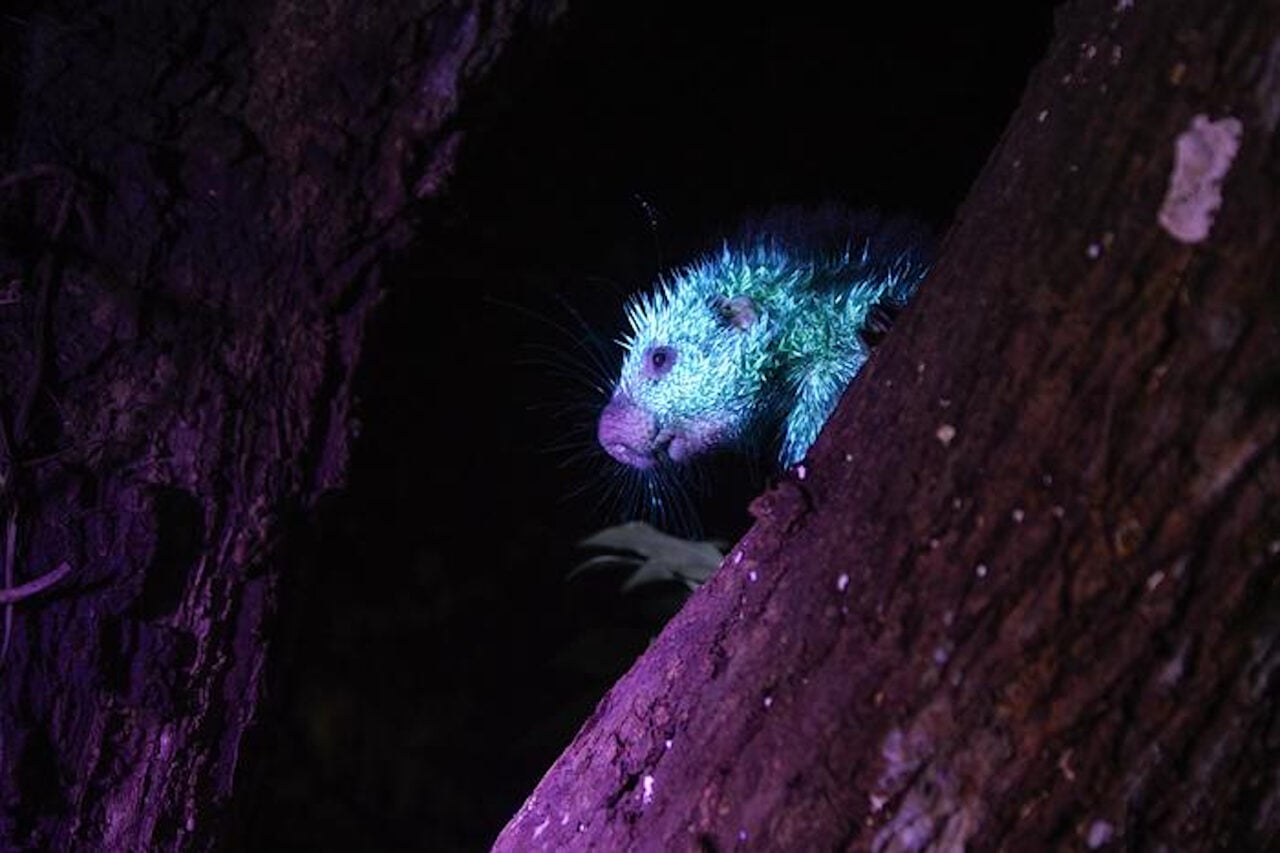
The trees of Mexico’s seaside city of Chetumal, along its southern border with Belize, have a small, solitary, nocturnal interloper who smells deceptively like human gym-rat body odor, the Mexican hairy dwarf porcupine. For years, conservation biologists and other wildlife researchers have been helping the city rescue, clinically test, and generally manage these smelly creatures as they climb around the city like curious, spiky toddlers.
Now, thanks to a discovery by wildlife veterinarian Jonathan Pérez-Flores, that challenging odd job has gotten a bit easier. Mexico’s hairy dwarf porcupine, Pérez-Flores and his partners report in a new study, glows in vivid shades of blue, green, and yellow under ultraviolet (UV) light, like it’s on its way to a rave. The researchers argue that simple, off-the-shelf tools—like the consumer LED UV flashlight that Pérez-Flores employed—“could be a useful tool for locating these animals in the wild.”
“To the best of our knowledge, no photoluminescence observations have ever been made in live individuals of the Mexican hairy dwarf porcupine (Coendou mexicanus),” Pérez-Flores, the study’s senior author, and his colleagues wrote in their study.
But, then again, there’s a lot that scientists don’t know about C. mexicanus. While international conservationists list the porcupine in the “Least Concern”