📰 Newspapers

Europe's Hera mission returns to the chaotic scene of a cosmic smashup

Europe's Hera mission returns to the chaotic scene of a cosmic smashup

"DART made a really, really large mess. However, we didn’t really know what kind of mess."

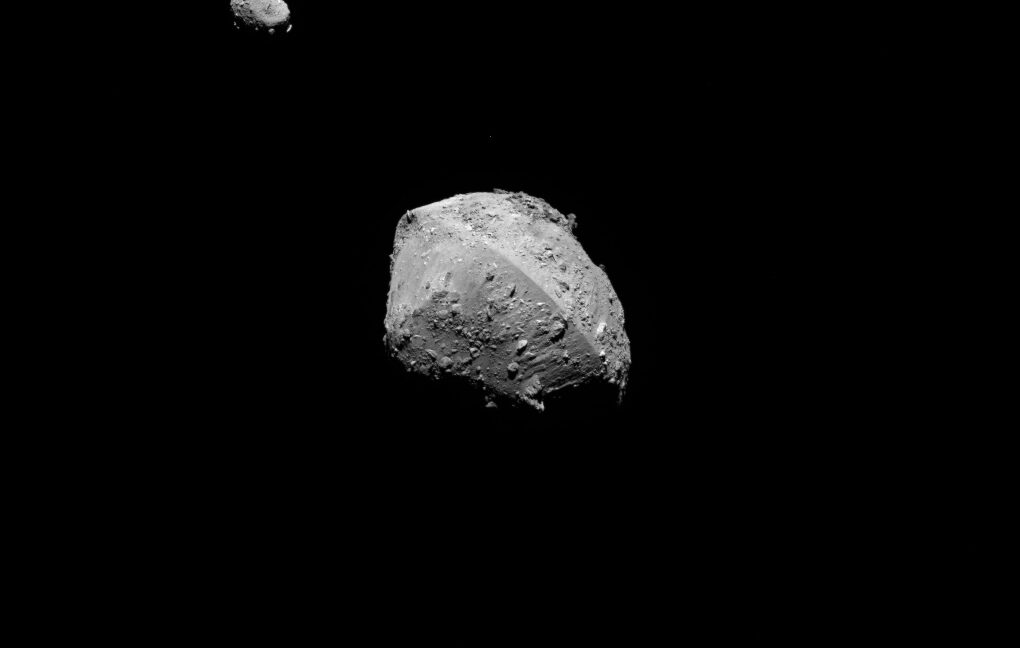
Four years ago, NASA dispatched a small spacecraft on a suicide mission to show how humanity might deflect an asteroid on a collision course with Earth. The first-of-its-kind experiment worked beautifully as the solar-powered space probe slammed into asteroid Dimorphos, permanently altering its trajectory.

Using telescopes, astronomers measured changes in the orbit of Dimorphos around a larger asteroid companion named Didymos in the aftermath of NASA's Double Asteroid Redirection Test (DART) mission. The spacecraft released some 10 billion joules of energy as it impacted Dimorphos in September 2022 at more than 13,700 mph (6.14 kilometers per second), shortening the asteroid's 12-hour orbit around Didymos by about 33 minutes, 25 times the most conservative expectation.

But scientists could only learn so much from DART. The collision destroyed the spacecraft, as expected. DART recorded images as it took aim on Dimorphos, but only faraway telescopes and a small CubeSat that briefly detected the impact flash could see what happened next.

"We knew right away that the impact was successful, that DART made a really, really large mess," said Sabina Raducan, a planetary scientist at the International Space Science Institute in Bern, Switzerland. "However, we didn’t really know what kind of mess. We were still missing pieces of the puzzle."

In brief

Four years ago, NASA dispatched a small spacecraft on a suicide mission to show how humanity might deflect an asteroid on a collision course with Earth. Using telescopes, astronomers measured changes in the orbit of Dimorphos around a larger asteroid companion named Didymos in the aftermath of NASA's Double Asteroid Redirection Test (DART) mission. "However, we didn’t really know what kind of mess.

This is the opening of the story, shared with credit to Ars Technica. The rest of the report — with every detail — continues on the publisher’s website.

Continue reading at Ars Technica ↗

Cookie settings

Choose which cookies we may use. You can change this at any time from Cookie settings in the footer. Details of each cookie are in the Cookie Policy.

Strictly necessary

Needed for sign-in, security, payments and remembering these choices. Always on.

Preferences

Remember settings such as dark mode.

Analytics & performance

Help us count visits, understand which pages, devices and countries our readers use, and measure how well the site performs – anonymous and aggregated.

Advertising & marketing

Lets advertising partners show and personalise adverts, measure impressions, clicks and visits, prevent ad fraud and pay us – this is how the free site is funded.

🔔 News notifications

Get headlines from NewsHub on this device — even when the site is closed.

You can switch this off at any time. Works on Android, Windows, Mac and Linux browsers; on iPhone/iPad add the site to your Home Screen first.