📰 Newspapers

Scientists Thought Volcanic Blasts Couldn’t Happen This Deep. This Robot Just Pulled Up Something Unexpected

Scientists Thought Volcanic Blasts Couldn’t Happen This Deep. This Robot Just Pulled Up Something Unexpected

The research may also explain why Challenger Deep is so deep.

Despite significant advances in humanity’s spaceflight capabilities, the deep sea on our own planet remains woefully underexplored. But when scientists do find ways to sleuth the deep, the discoveries are often deeply surprising.

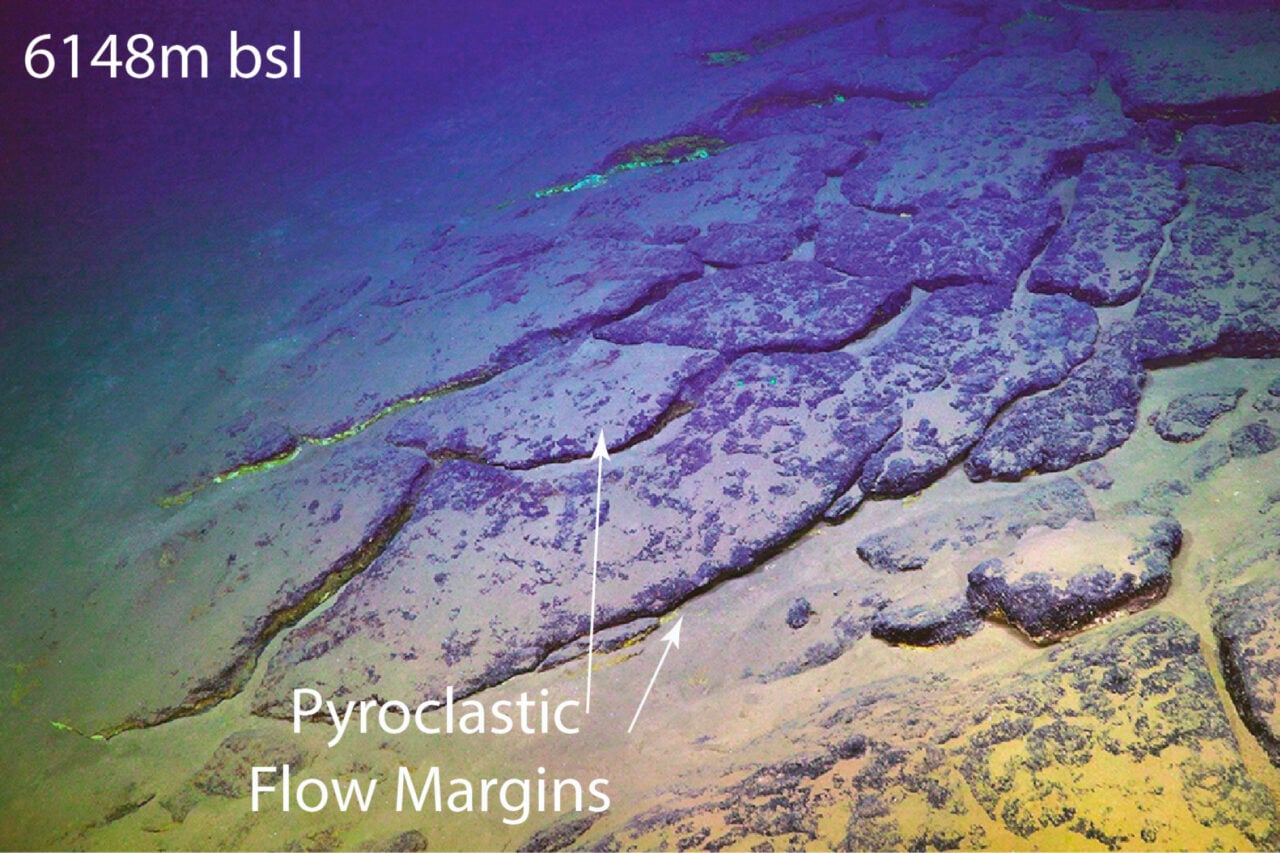
According to geoscientist Ignacio Pujana, sending anything down to explore the deep sea—especially the trenches—is an expensive and difficult task. Pujana, of the University of Texas at Dallas, was part of the team that sent Jason/Medea, a remotely operated vehicle capable of diving up to 4 miles (6.5 kilometers) below sea level. That technically wasn’t enough to directly probe Challenger Deep—the deepest known point of the seabed—at 6.8 miles (11 kilometers). Still, the vehicle was able to sample the wall of this trench. And during its journey, Jason/Medea retrieved clear evidence of ultra-deep volcanic eruptions: pyroclastic rocks. A paper published today in Frontiers in Earth Science describes the expedition and its findings in further detail.

“We sampled and are studying both mantle rocks and the young volcanic rocks,” Pujana told Gizmodo. “[What’s] especially interesting is that we discovered that explosive volcanism occurs much deeper and closer to the trench than anybody previously imagined.”

When we think of the deepest point of the ocean, we think of the Mariana Trench. Challenger Deep is the deepest point of that deepest point.

In brief

Despite significant advances in humanity’s spaceflight capabilities, the deep sea on our own planet remains woefully underexplored. That technically wasn’t enough to directly probe Challenger Deep—the deepest known point of the seabed—at 6.8 miles (11 kilometers). And during its journey, Jason/Medea retrieved clear evidence of ultra-deep volcanic eruptions: pyroclastic rocks. Challenger Deep is the deepest point of that deepest point.

This is the opening of the story, shared with credit to Gizmodo. The rest of the report — with every detail — continues on the publisher’s website.

Continue reading at Gizmodo ↗

Cookie settings

Choose which cookies we may use. You can change this at any time from Cookie settings in the footer. Details of each cookie are in the Cookie Policy.

Strictly necessary

Needed for sign-in, security, payments and remembering these choices. Always on.

Preferences

Remember settings such as dark mode.

Analytics & performance

Help us count visits, understand which pages, devices and countries our readers use, and measure how well the site performs – anonymous and aggregated.

Advertising & marketing

Lets advertising partners show and personalise adverts, measure impressions, clicks and visits, prevent ad fraud and pay us – this is how the free site is funded.

🔔 News notifications

Get headlines from NewsHub on this device — even when the site is closed.

You can switch this off at any time. Works on Android, Windows, Mac and Linux browsers; on iPhone/iPad add the site to your Home Screen first.